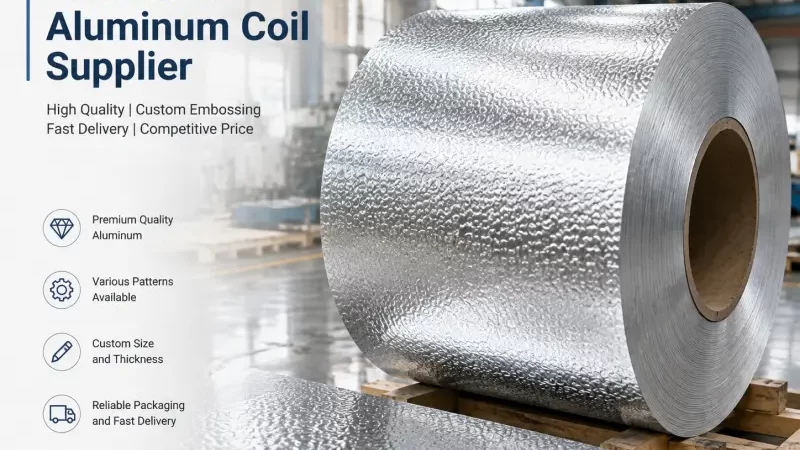
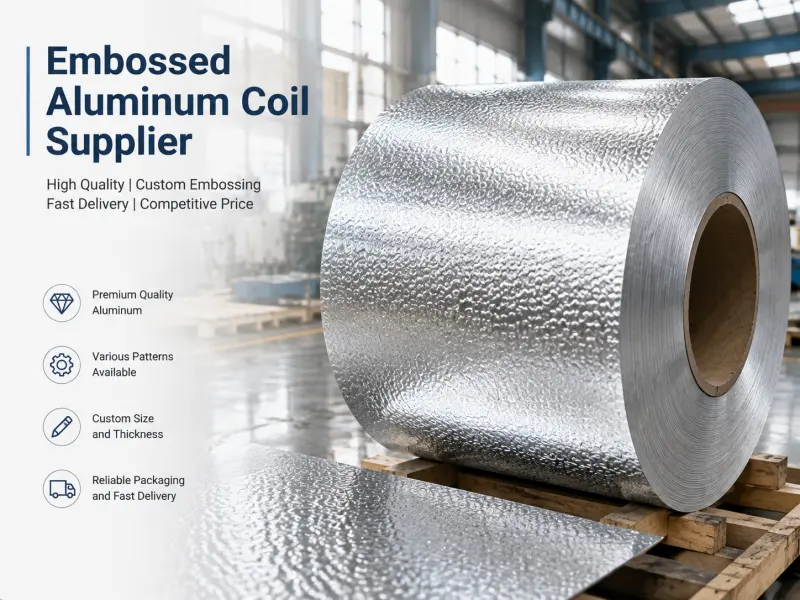
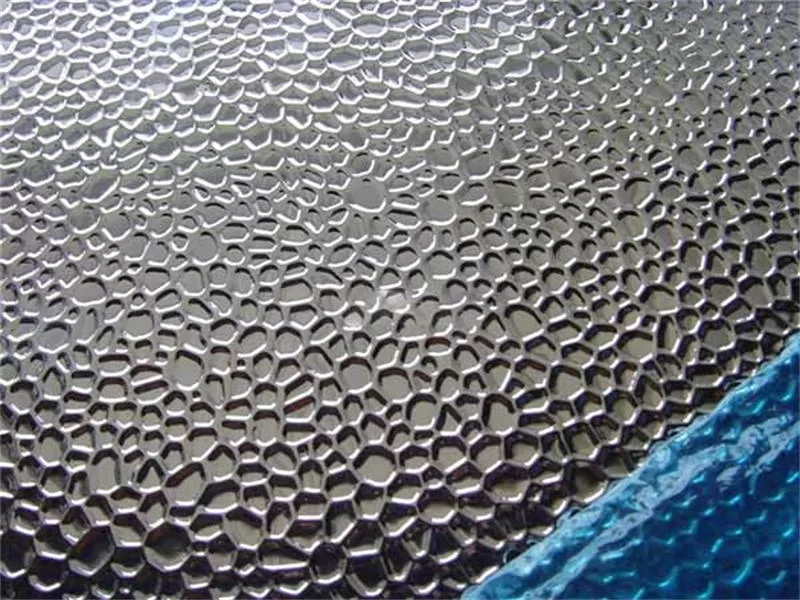
Embossed Aluminum Coil Supplier is premium metal products featuring raised decorative patterns on the surface.
These coils combine functionality with aesthetic appeal, making them ideal for architectural and design applications where both durability and visual impact matter.
Key Advantages:
Enhanced slip resistance
Superior light diffusion
Excellent formability
Unique decorative effects
Classification of Embossed Aluminum Coils
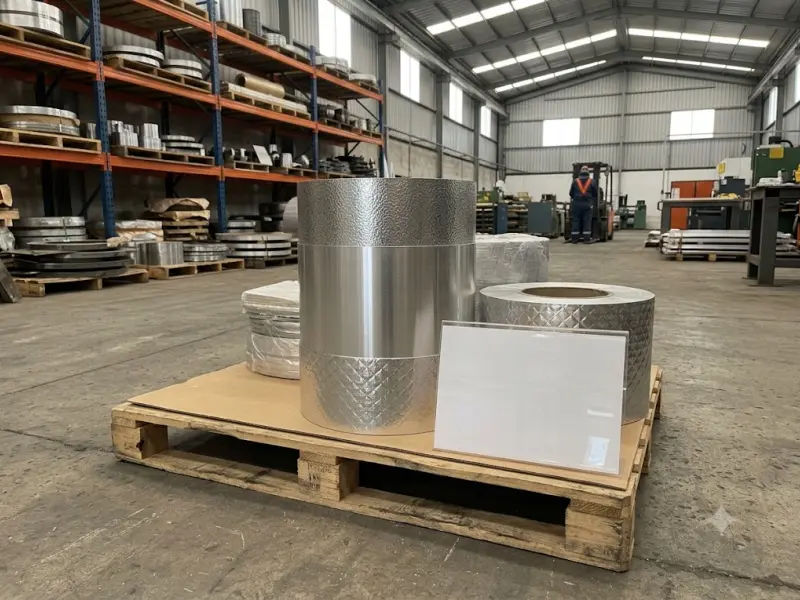
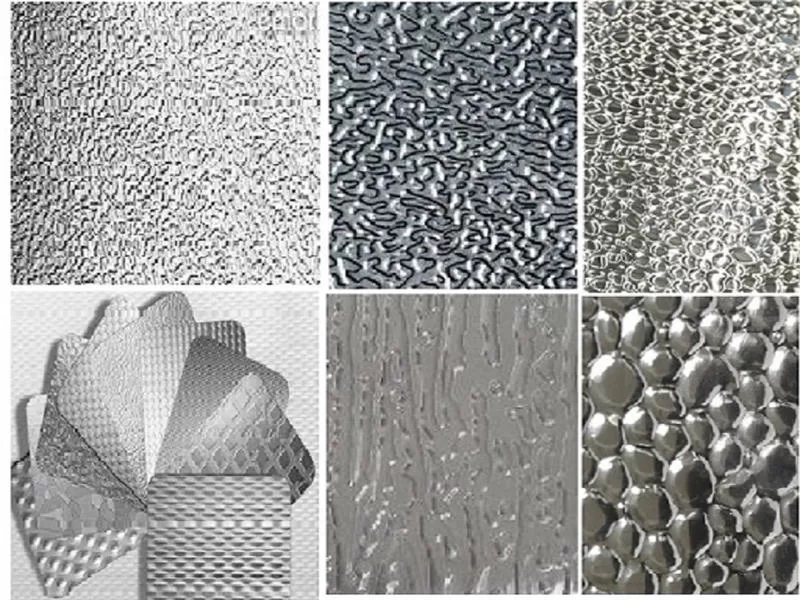
Suppliers typically offer these main pattern types:
| Pattern Type | Depth (mm) | Best For | Finish Options |
|---|---|---|---|
| Diamond Embossed | 0.1-0.3 | Flooring, Wall Cladding | Mill, Anodized |
| Leather Grain | 0.2-0.5 | Elevator Interiors, Furniture | Painted, PVDF |
| Linear Grooved | 0.15-0.25 | Ceiling Panels, Partitions | Brushed, Coated |
| Custom Designs | 0.1-0.4 | Signature Architecture | All Finishes |
Thickness Specifications
Standard thickness options from suppliers:
| Thickness (mm) | Width Range (mm) | Typical Applications |
|---|---|---|
| 0.5-0.8 | 800-1600 | Interior Decorative Panels |
| 0.8-1.2 | 900-1500 | Building Facades |
| 1.2-2.0 | 1000-2000 | Heavy-Duty Flooring |
| 2.0-3.0 | 1200-2500 | Industrial Applications |
Alloy Options
Leading suppliers provide these common alloys:
| Alloy Series | Characteristics | Pattern Suitability |
|---|---|---|
| 3003 | Excellent formability | Complex deep patterns |
| 5005 | Good corrosion resistance | Standard embossing |
| 5052 | Higher strength | Heavy-duty applications |
| 6061 | Structural applications | Minimal pattern deformation |
Packaging Standards
Quality suppliers ensure:
PVC film interleaving (pattern protection)
Waterproof wrapping (30-100m per coil)
Steel or wooden pallet bases
Edge protectors for all shipments
Custom packaging for special orders
Top 5 Industries Using Embossed Aluminum Coils
Artistic installations
Architecture & Construction
Decorative wall panels
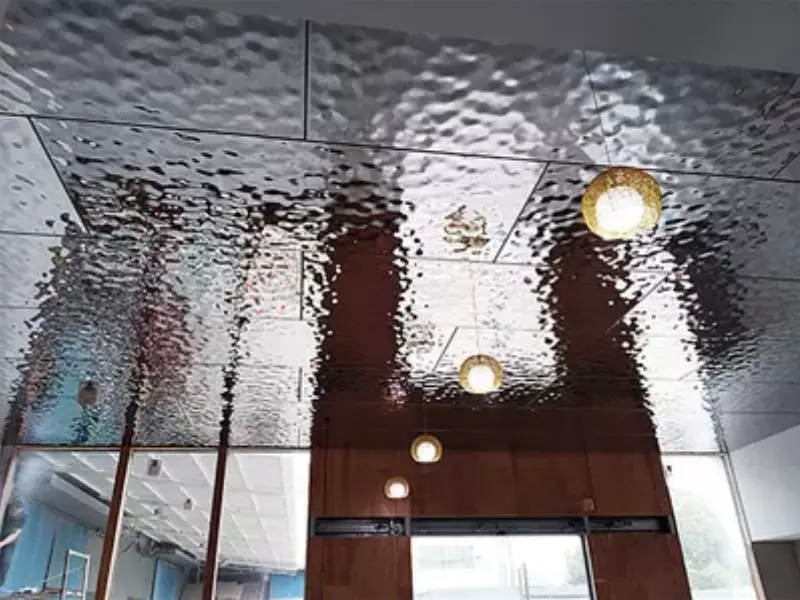
Ceiling systems
Column covers
Transportation
RV interiors
Marine ceilings
Train compartment linings
Interior Design
Feature walls
Custom furniture surfaces
Retail display backdrops
Industrial Applications
Non-slip walkways
Equipment housings
Machinery decoration
Consumer Goods
Appliance exteriors
DIY project materials
Supplier Selection Criteria
When evaluating embossed aluminum coil suppliers, consider:
Pattern consistency across batches
Minimum order quantities (MOQs)
Custom pattern development capability
Finishing options availability
Lead time reliability
Quality Assurance Indicators
Reputable suppliers provide:
Mill test certificates
Sample approval process
Pattern depth verification
Surface quality guarantees
Consistent mechanical properties
Cost Factors
Pricing depends on:
Alloy grade
Pattern complexity
Order volume
Finish type
Packaging requirements
Global Supply Considerations
Major supplying regions:
Asia (China, India) – Cost competitive
Europe (Germany, Italy) – Premium quality
North America – Quick turnaround
Maintenance Requirements
- Embossed aluminum coils require:
- Regular cleaning with mild detergents
- Avoidance of abrasive tools
- Periodic inspection for deep patterns
- Touch-up painting when coated
Choosing the right embossed aluminum coil supplier
Choosing the right embossed aluminum coil supplier requires balancing pattern quality, material specifications, and service reliability. Whether sourcing standard diamond patterns or custom-designed surfaces, prioritize suppliers with proven embossing expertise and quality control systems.
For architectural projects, consider suppliers offering:
Full technical support
Sample matching services
Installation guidance
After-sales support
What Is an Embossed Aluminum Coil?
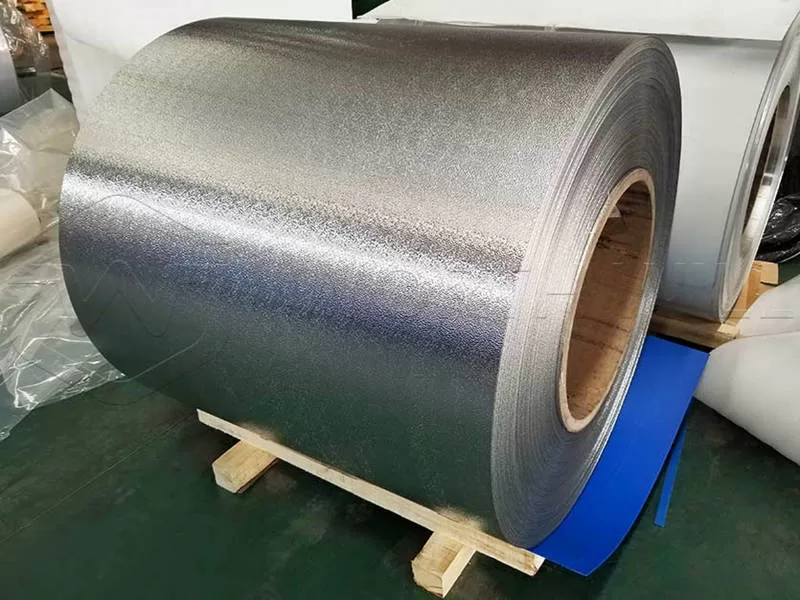
An embossed aluminum coil is a roll of aluminum sheet that carries a raised pattern on its surface. The pattern is pressed into the metal using large engraved rollers. The result is a textured finish that adds grip, hides scratches, and improves stiffness.
These coils arrive at your factory ready to unroll, cut, and form. The embossed surface is not just for looks. It increases the strength of thin aluminum without adding weight. It also breaks up reflected light, which reduces glare.
A reliable embossed aluminum coil supplier offers multiple alloys, tempers, and patterns. The right mix of these factors decides how the coil performs in your end product.
Why Texture Matters on Aluminum
Plain aluminum sheet is smooth. It scratches easily and shows every dent. Embossing changes the game.
- Hides damage: Small scratches disappear in the pattern.
- Adds rigidity: The raised profile stiffens the sheet against bending.
- Improves grip: Workers and tools handle textured metal more safely.
- Reduces glare: The uneven surface scatters light instead of reflecting it.
- Helps adhesion: Paint and insulation stick better to a textured face.
- Hides oil streaks: Rolling lubricant marks are less visible.
Because of these benefits, embossed aluminum coil is common in roofing, insulation, packaging, and transportation.
Alloy Types Behind the Pattern
The alloy is the DNA of the coil. It sets the strength, the price, and the environment where the metal can live.
1050 Embossed Aluminum Coil
This is a near-pure aluminum grade. It contains at least 99.5% aluminum.
| Property | Value |
|---|---|
| Purity | ≥99.5% Al |
| Temper range | O, H14, H24 |
| Tensile strength | 60–110 MPa (O) |
| Corrosion resistance | Very good |
| Cost | Low |
| Best use | Decorative panels, light cladding |
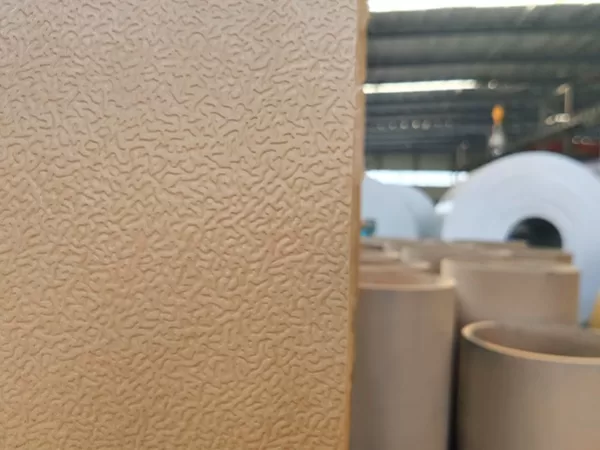
The 1050 grade is soft and takes embossing very well. The pattern forms cleanly without cracking. It is a budget-friendly choice for indoor and light outdoor use.
1060 Embossed Aluminum Coil
With 99.6% purity, this grade offers a cleaner surface than 1050.
| Property | Value |
|---|---|
| Purity | ≥99.6% Al |
| Temper range | O, H14, H24 |
| Surface finish | Very smooth before embossing |
| Cost | Low to medium |
| Best use | Reflective embossed panels, signage |
1060 is often used when the embossed coil will later be anodized or painted. The higher purity gives a more even coating result.
1100 Embossed Aluminum Coil
This is the general-purpose pure aluminum grade.
| Property | Value |
|---|---|
| Purity | ≥99.0% Al |
| Temper range | O, H12, H14, H16 |
| Strength | Slightly higher than 1050 |
| Weldability | Excellent |
| Best use | HVAC cladding, insulation jackets |
1100 balances cost and workability. It is the workhorse of the embossed coil world.
3003 Embossed Aluminum Coil
This alloy adds manganese. It is stronger than the pure grades.
| Property | Value |
|---|---|
| Manganese | 1.0–1.5% |
| Temper range | O, H12, H14, H16, H24 |
| Tensile strength | 120–165 MPa (H14) |
| Corrosion resistance | Good |
| Best use | Roofing, wall panels, trailers |
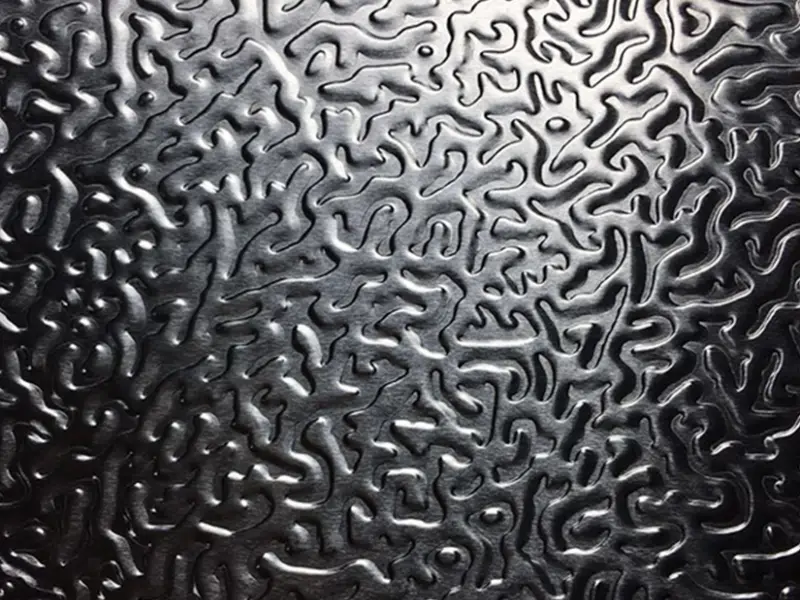
3003 is the most common alloy for embossed roofing and siding coils. It resists weather and holds its shape under wind load. The pattern adds even more strength to this already tough alloy.
3004 Embossed Aluminum Coil
A close cousin of 3003 with added magnesium.
| Property | Value |
|---|---|
| Magnesium | 0.8–1.3% |
| Strength | Higher than 3003 |
| Formability | Good |
| Best use | Shingle roofing, deep-drawn panels |
3004 is popular in the building industry when deeper profiles or sharper bends are needed.
3105 Embossed Aluminum Coil
This grade is designed specifically for sheet metal work.
| Property | Value |
|---|---|
| Temper range | H14, H16, H18, H25 |
| Corrosion resistance | Very good |
| Paint adhesion | Excellent |
| Best use | Pre-painted embossed roofing, gutters |
3105 is often the choice when the embossed coil will be color-coated before delivery. It takes paint and holds it through years of sun and rain.
5052 Embossed Aluminum Coil
This alloy contains magnesium. It offers the highest strength among common embossed coil grades.
| Property | Value |
|---|---|
| Magnesium | 2.2–2.8% |
| Temper range | O, H32, H34 |
| Tensile strength | 210–260 MPa (H32) |
| Marine resistance | Excellent |
| Best use | Marine decking, truck bodies, harsh environments |
5052 embossed coil costs more but survives salt air, road chemicals, and heavy handling. It is worth the price for coastal roofing and transport applications.
5005 Embossed Aluminum Coil
A medium-strength alloy with excellent anodizing response.
| Property | Value |
|---|---|
| Temper range | O, H14, H16, H34 |
| Anodizing quality | Excellent |
| Best use | Anodized embossed trim, architectural panels |
5005 is chosen when the final product needs a colored or clear anodized layer over the embossed texture.
Temper States and Workability
The temper tells you how hard the coil is and how much you can bend it before it cracks.
| Temper | Description | Feel | Best For |
|---|---|---|---|
| O | Fully annealed, soft | Very pliable | Deep drawing, complex forming |
| H12 | Quarter hard | Slight stiffness | Light forming, easy bending |
| H14 | Half hard | Moderate stiffness | General roofing, wall panels |
| H16 | Three-quarter hard | Fairly stiff | Rigid panels, standing seam |
| H18 | Full hard | Very stiff | Flat sheets, minimal forming |
| H22 | Quarter hard, stabilized | Less warp than H12 | Large flat panels |
| H24 | Half hard, stabilized | Balanced | Most popular for embossed coils |
| H32 | Quarter hard, 5000 series | Good form plus strength | 5052 roofing and decking |
For most embossed aluminum coil orders, H14 and H24 are the standard choices. They hold the pattern well and still allow bending into panels or profiles.
Thickness Options for Every Job
Thickness changes how the coil feels, how deep the embossing looks, and how much load it carries.
Light-Duty Thickness
| Thickness | Weight per m² | Typical use | Pattern depth note |
|---|---|---|---|
| 0.2 mm | ~0.54 kg | Foil lids, labels, craft | Shallow pattern only |
| 0.3 mm | ~0.81 kg | Packaging, thin insulation | Light texture |
| 0.4 mm | ~1.08 kg | Decorative trim, ceiling tiles | Moderate pattern |
Thin coils are easy to roll and ship. The embossing must be shallow to avoid tearing the metal.
Standard Thickness
| Thickness | Weight per m² | Typical use | Pattern depth note |
|---|---|---|---|
| 0.5 mm | ~1.35 kg | Standard roofing, wall cladding | Full pattern possible |
| 0.6 mm | ~1.62 kg | Guttering, soffits, fascia | Good pattern definition |
| 0.7 mm | ~1.89 kg | Industrial roofing, trailer siding | Deep embossing holds well |
| 0.8 mm | ~2.16 kg | Heavy-duty cladding, truck bodies | Very crisp texture |
This range covers about 80% of the embossed coil market. The metal is thick enough to take a deep pattern without weakening.
Heavy-Duty Thickness
| Thickness | Weight per m² | Typical use | Pattern depth note |
|---|---|---|---|
| 1.0 mm | ~2.70 kg | Structural panels, machine guards | Maximum relief |
| 1.2 mm | ~3.24 kg | Walkable decking, heavy roofing | Deep, aggressive texture |
| 1.5 mm | ~4.05 kg | Platforms, ramps, industrial floors | Extreme pattern depth |
| 2.0 mm | ~5.40 kg | Armor-like cladding, heavy equipment | Very pronounced texture |
Thicker coils are harder to emboss. They need heavier rolling mills. The result is a bold texture that hides major dents and provides serious anti-slip grip.
Pattern Styles and What They Do
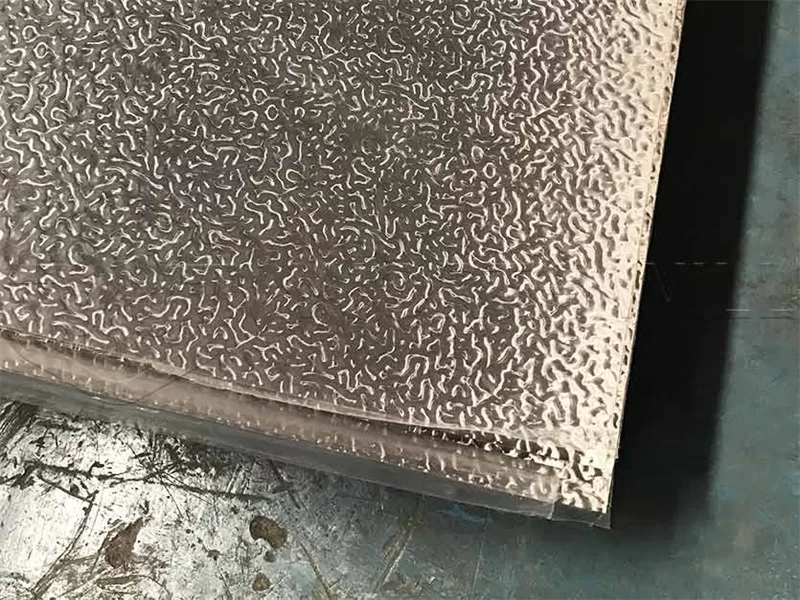
The pattern name tells you the look and the function. Different industries prefer different textures.
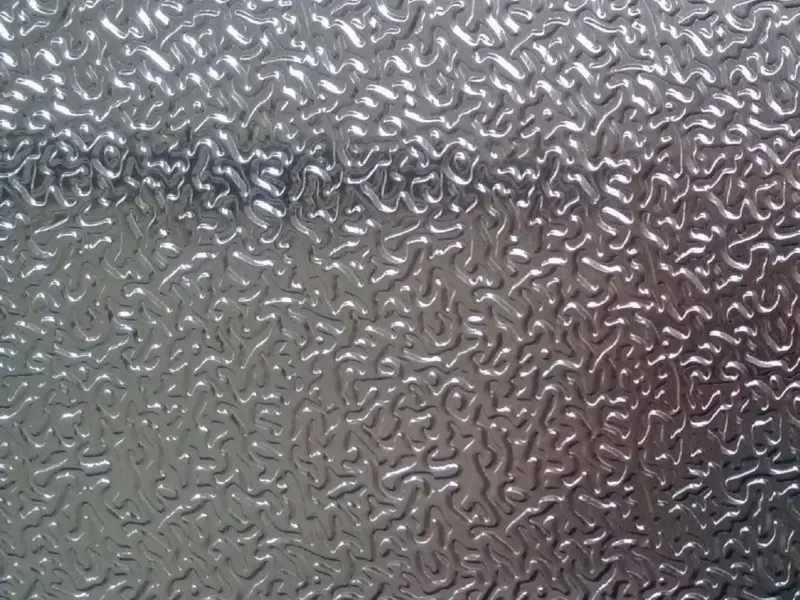
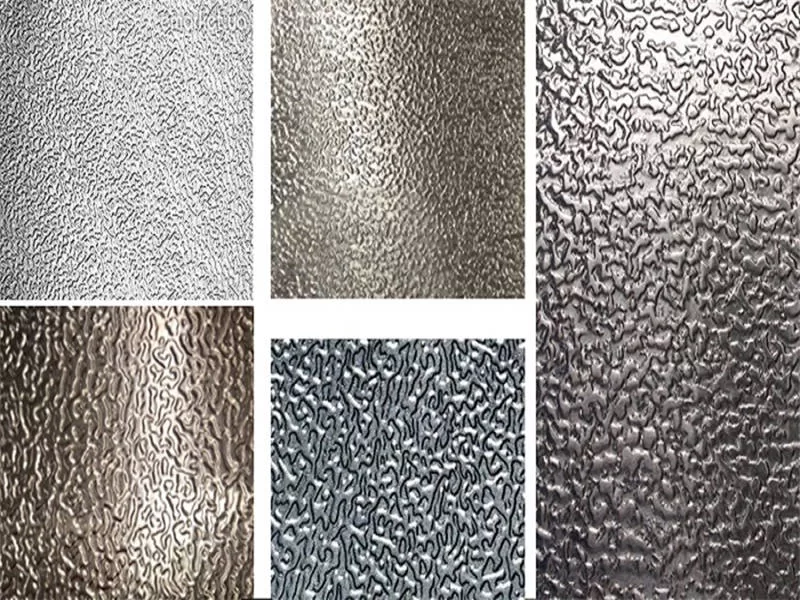
Stucco Pattern
This is the most common embossing style. It looks like rough plaster or orange peel.
| Feature | Detail |
|---|---|
| Appearance | Random, bumpy, matte |
| Glare reduction | Excellent |
| Scratch hiding | Excellent |
| Best use | Roofing, insulation, general cladding |
Stucco embossed aluminum coil is everywhere in the building trade. It is the default choice when a buyer asks for “embossed coil” without naming a pattern.
Diamond Pattern
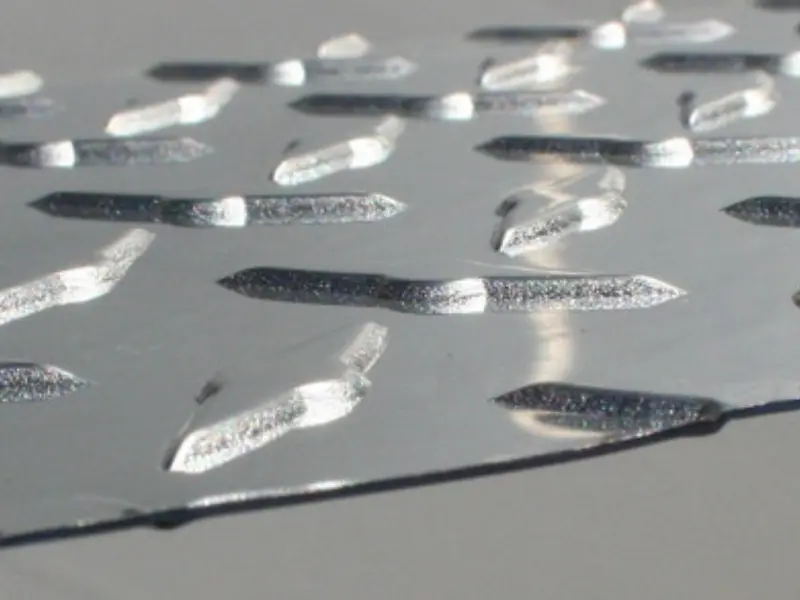
Raised diamond shapes cover the surface in a regular grid.
| Feature | Detail |
|---|---|
| Appearance | Geometric, ordered |
| Grip level | High |
| Stiffness boost | High |
| Best use | Flooring, tool boxes, step treads, decorative trim |
The diamond pattern adds more rigidity than stucco because the lines run in set directions. It is popular in transportation and machinery.
Hammer Pattern
Small, irregular dimples cover the sheet like hammer marks.
| Feature | Detail |
|---|---|
| Appearance | Artisan, hand-worked look |
| Light reflection | Diffuse |
| Best use | Decorative panels, interior design, appliance fronts |
Hammer embossed coil gives a premium, crafted appearance. It is common on refrigerator doors and high-end wall panels.
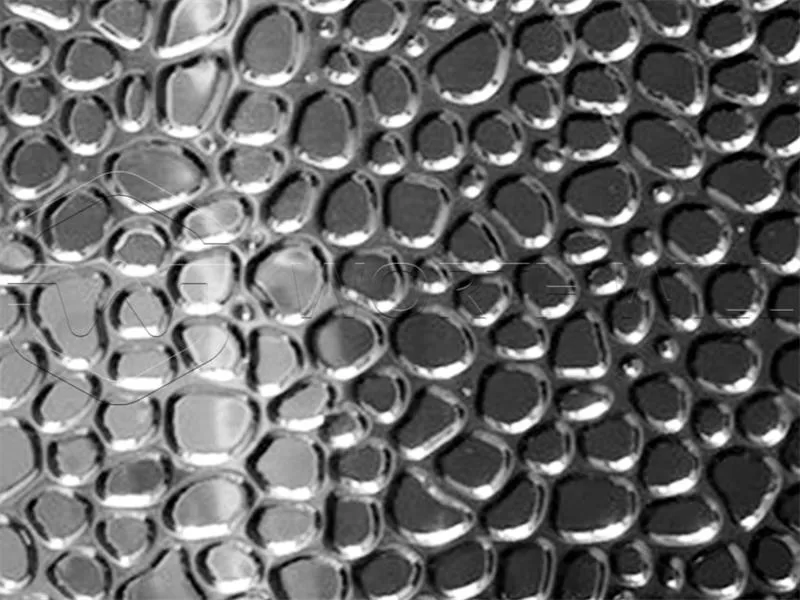
Pebble Pattern
Rounded bumps that look like small stones.
| Feature | Detail |
|---|---|
| Appearance | Smooth, rounded texture |
| Touch feel | Soft, less aggressive |
| Best use | Interior cladding, ceiling tiles, furniture |
Pebble is less industrial than stucco. Designers use it when the metal must look friendly and modern.
Linen Pattern
Fine cross-hatched lines that look like fabric weave.
| Feature | Detail |
|---|---|
| Appearance | Subtle, elegant |
| Glare | Very low |
| Best use | Lighting fixtures, high-end appliances, signage |
Linen embossed aluminum coil is a niche product. It costs more but delivers a unique, refined look.
Checker Pattern
Also known as tread plate pattern. Raised squares or diamonds with flat areas between.
| Feature | Detail |
|---|---|
| Appearance | Bold, high contrast |
| Anti-slip | Excellent |
| Best use | Ramps, steps, vehicle floors, work platforms |
Checker embossed coil is essentially thin tread plate in roll form. It saves weight compared to thick plate while keeping the grip.
Pattern Comparison Table
| Pattern | Grip | Rigidity | Hides scratches | Typical alloy | Common thickness |
|---|---|---|---|---|---|
| Stucco | Low | Medium | Excellent | 3003, 1100 | 0.4–0.8 mm |
| Diamond | High | High | Good | 3003, 5052 | 0.5–1.2 mm |
| Hammer | Medium | Medium | Good | 1060, 1100 | 0.3–0.6 mm |
| Pebble | Low | Low | Good | 1050, 1100 | 0.4–0.8 mm |
| Linen | Low | Low | Fair | 1060, 5005 | 0.3–0.5 mm |
| Checker | Very high | Very high | Excellent | 3003, 5052 | 0.8–2.0 mm |
Width and Coil Weight Standards
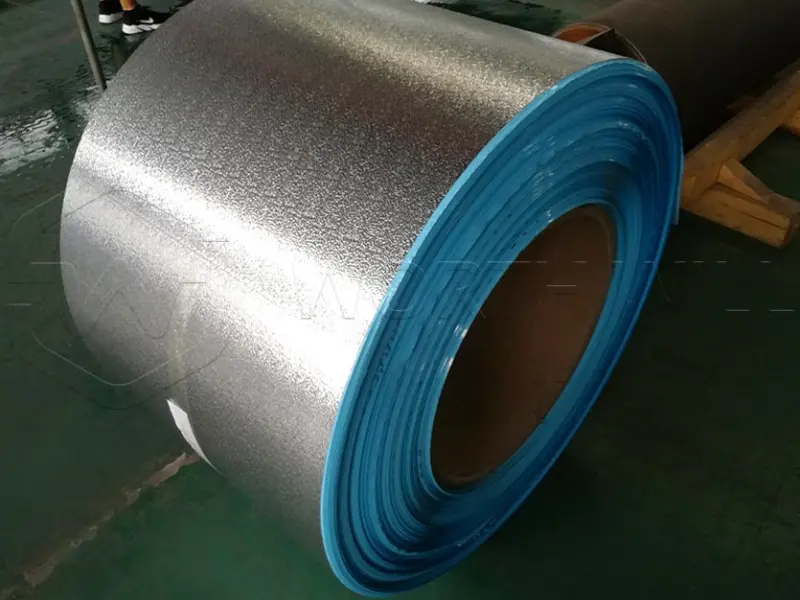

Suppliers stock coils in standard widths to reduce waste. Custom slitting is always available.
| Standard width | Common use | Typical coil weight |
|---|---|---|
| 600 mm | Small roofing jobs, flashing | 1.5–2.5 tons |
| 800 mm | European standard cladding | 2–3 tons |
| 1000 mm | General roofing, wall panels | 2.5–4 tons |
| 1200 mm | Wide-span roofing, industrial | 3–5 tons |
| 1250 mm | Common mill width | 3–5 tons |
| 1500 mm | Maximum standard width | 4–6 tons |
Coil weight affects shipping cost and how long your line can run before a changeover. Heavier coils mean fewer stops but require stronger uncoiling equipment.
Alloy Comparison at a Glance
Choosing the right base metal can be tricky. This table breaks down the key differences for embossed coil buyers.
| Feature | 1050 | 1100 | 3003 | 3105 | 5052 |
|---|---|---|---|---|---|
| Purity | Very high | High | Medium | Medium | Medium |
| Strength | Low | Low | Medium | Medium | High |
| Formability | Excellent | Excellent | Good | Good | Good |
| Corrosion resistance | Good | Good | Good | Very good | Excellent |
| Paint adhesion | Fair | Fair | Good | Excellent | Good |
| Cost | $ | $ | $$ | $$ | $$$ |
| Best product | Decorative trim | General cladding | Roofing, siding | Pre-painted roofing | Marine, heavy duty |
Quick guide:
- Budget decorative work → 1050 or 1100
- Standard roofing and wall → 3003
- Pre-painted or color-coated → 3105
- Coastal or chemical exposure → 5052
Embossed aluminum coil serves many industries. Here is where it adds the most value.
Applications That Rely on Embossed Coils
Building and Roofing
The construction industry is the largest user of embossed aluminum coil.
- Standing seam metal roofs
- Corrugated wall panels
- Soffit and fascia covers
- Guttering systems
- Insulation jacketing
- Garage door panels
The stucco pattern hides the small dents that happen during installation. It also reduces the sun glare that bothers workers on bright days.
Transportation
Weight matters in trucks, buses, and trailers.
- Trailer side panels
- Bus interior cladding
- Truck bed liners
- Refrigerated vehicle walls
- Train carriage trim
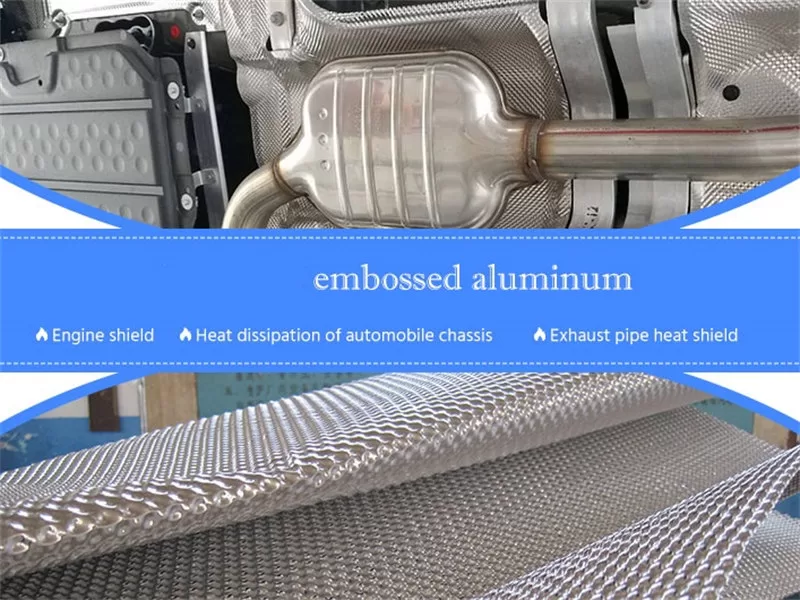
Embossing adds stiffness to thin panels. This lets manufacturers use lighter metal without sacrificing strength.

Appliance Manufacturing
Home appliances use embossed aluminum for both looks and function.
- Refrigerator door panels
- Oven and microwave fronts
- Air conditioner housings
- Washing machine drums
- Dryer panels
The hammer or pebble pattern gives appliances a modern, fingerprint-resistant surface.
Lighting and Reflectors
Some embossed coils are used in light fixtures.
- Diffuser panels
- Reflector housings
- Ceiling troffers
- Outdoor lamp covers
The texture scatters light evenly. This prevents hot spots and glare in LED installations.
HVAC and Insulation
Aluminum does not rust and reflects heat. Embossing helps it hold insulation in place.
- Pipe insulation cladding
- Ductwork wrap
- Air handling unit covers
- Boiler jacketing
- Cryogenic tank insulation
The stucco texture grips the insulation layer. Tape and bands stay in place better on embossed metal than on smooth sheet.
Packaging and Food
Some embossed aluminum is used in food-safe applications.
- Bottle cap stock
- Container lids
- Chocolate wrapping
- Yogurt foil lids
- Take-away container bases
The pattern can add grip for opening or provide a decorative look for premium packaging.
How to Pick the Right Coil for Your Project
Ask yourself these questions before you place an order.
Will the coil be painted or anodized after delivery?
→ Choose 3105 or 5005. These alloys take coating better than pure grades.
Is the project near the ocean or in a chemical plant?
→ Move up to 5052. The magnesium content fights salt and acid.
Do you need deep drawing or complex forming?
→ Use O temper or 1050/1100 alloy. Soft metal flows into dies without tearing.
Is the panel structural or just a skin?
→ Structural: 3003 H16 or 5052 H32. Skin: 1050 H14 or 1100 H24.
What pattern fits your end use?
→ Roofing and cladding: stucco. Flooring and steps: diamond or checker. Decoration: hammer or linen.
How wide does the coil need to be?
→ Match your press or roll former width. Standard sizes save money. Custom slitting adds cost.
Frequently Asked Questions
What is the difference between embossed and plain aluminum coil?

Plain coil has a smooth, flat surface. Embossed coil has a raised pattern pressed into the metal. The pattern adds stiffness, hides scratches, and reduces glare. Embossed coil often costs slightly more but needs less care after installation.
Which alloy is best for roofing embossed coils?
3003 H24 is the industry standard. It resists weather, holds the embossing well, and forms easily into roof panels. For coastal areas, 5052 H32 is a stronger choice. For budget jobs, 1100 H14 works in mild climates.
Can embossed aluminum coil be painted?
Yes. In fact, many embossed coils are pre-painted at the mill. The texture helps the paint stick. 3105 and 5005 are the best alloys for painted embossed coils. Always specify whether you want the paint on the embossed side or the smooth side.
What thickness works best for insulation cladding?
0.4 mm to 0.6 mm is standard for pipe and duct insulation jackets. This range is light enough to wrap by hand but stiff enough to hold its shape. 1100 or 3003 in stucco pattern are the most common choices.
Does the pattern affect the strength?
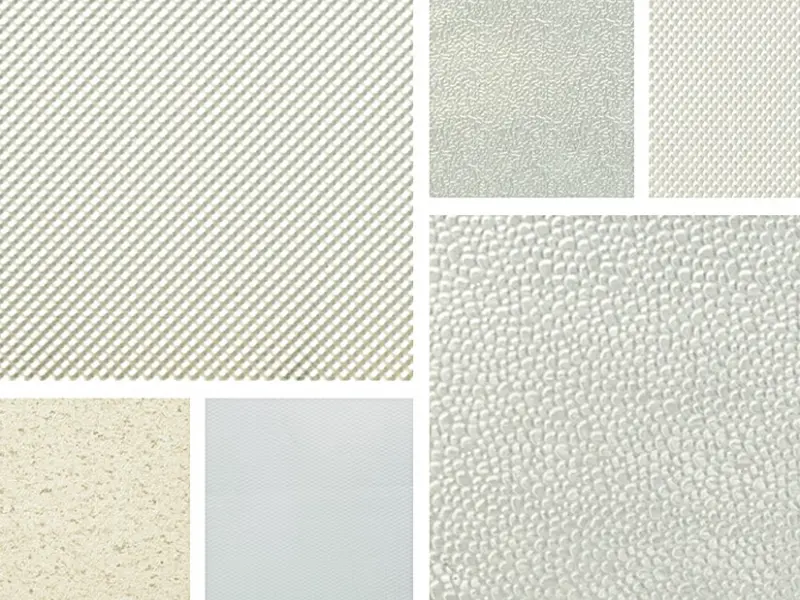
Yes. Embossing increases the effective stiffness of the sheet. A 0.5 mm embossed coil can feel as rigid as a 0.7 mm smooth sheet. However, the pattern also creates stress points. Very deep patterns on thin metal can tear if bent too sharply.
Is embossed aluminum coil expensive?
It usually costs 5% to 15% more than smooth coil of the same alloy and thickness. The extra price covers the embossing rollers and the slower production speed. For most buyers, the benefits in appearance and durability justify the small premium.
Can I use embossed coil for food packaging?
Yes, if the alloy and temper are food-grade. 1050 and 1100 are commonly used for food-contact aluminum. Make sure the supplier provides mill test certificates that confirm the metal meets food safety standards. The embossing itself does not affect food safety.
How do I clean embossed aluminum?
Use mild soap and water with a soft brush. The texture can trap dirt in the low spots. A nylon brush works well to reach into the pattern. Avoid steel wool or abrasive powders. These can leave dark marks on the aluminum surface.
What is the difference between stucco and diamond embossing?
Stucco is a random, bumpy pattern that looks like plaster. It is best for hiding scratches and reducing glare. Diamond is a regular grid of raised points. It adds more grip and stiffness. Stucco is for roofs and walls. Diamond is for floors, steps, and toolboxes.
Does embossed aluminum rust?
No. Aluminum does not rust like steel. It forms a natural oxide layer that protects the metal. Embossing does not change this. In very harsh environments, the high and low spots of the pattern can hold moisture slightly longer than smooth sheet. Regular cleaning prevents any issues.