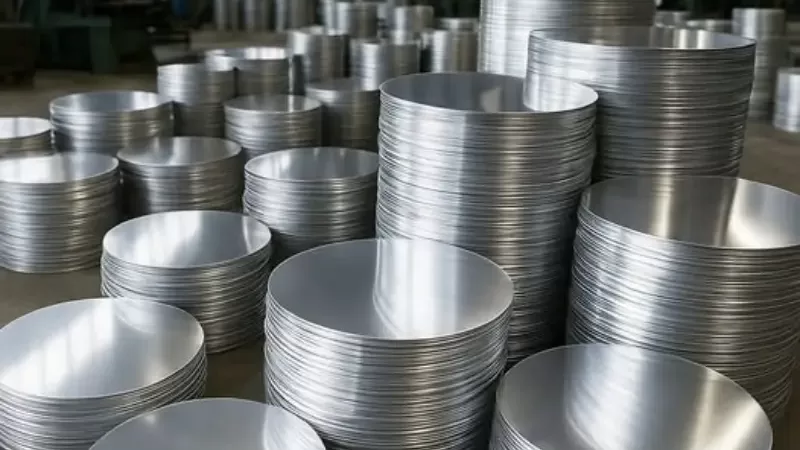
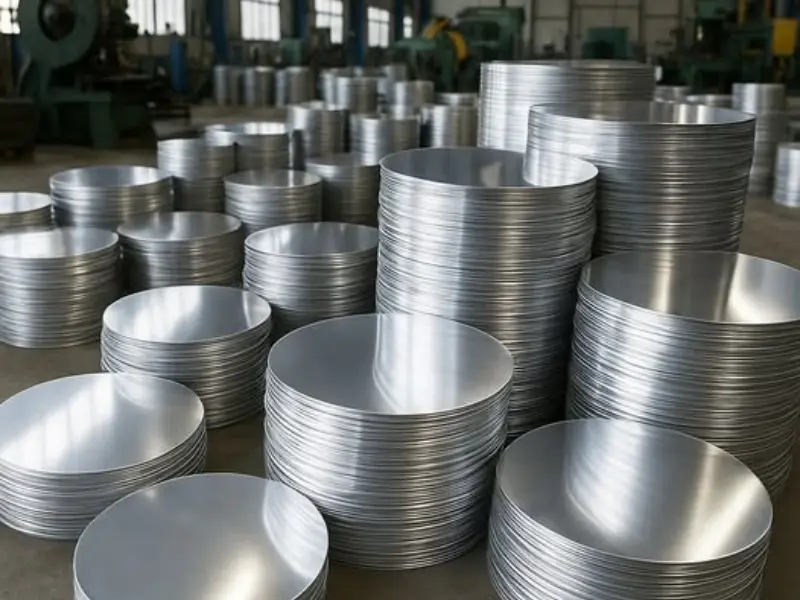
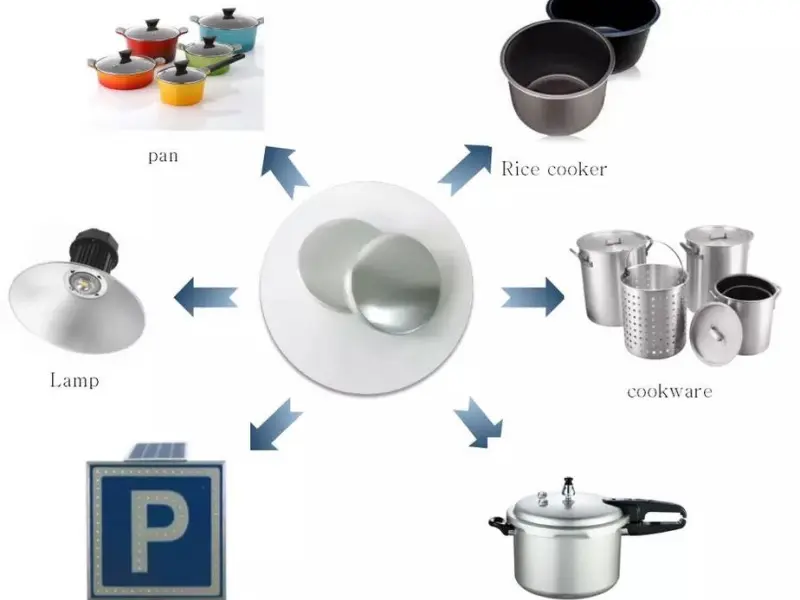
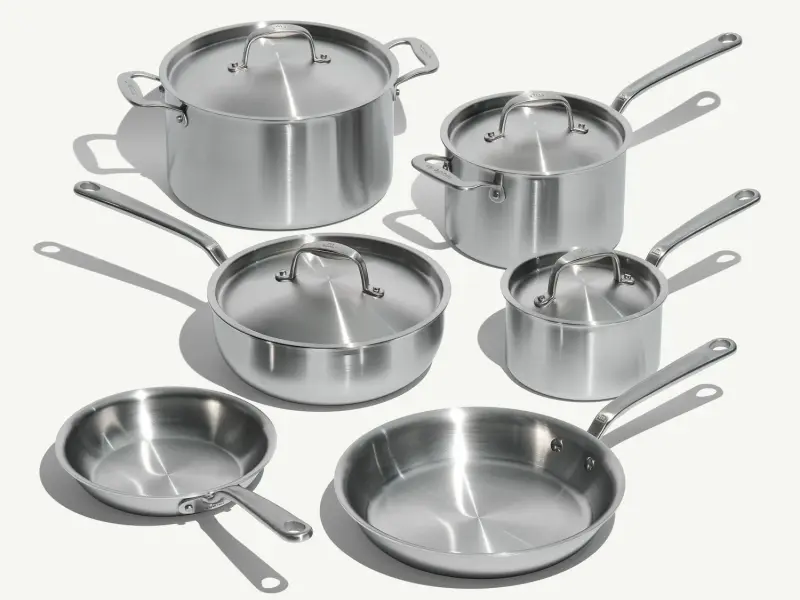
1050 1060 1100 Aluminum Circle is widely used in cookware, lighting, and industrial parts.
The most common alloys for this purpose are 1050, 1060, and 1100 aluminum. These alloys offer high ductility, smooth surface, and excellent deep drawing performance.
Classification of Aluminum Circle
Deep drawing aluminum discs are available in different sizes and alloys. They are mainly classified by:
- Alloy series: 1050, 1060, 1100
- Temper: O (soft), H12, H14, etc.
- Diameter range: 100mm – 1200mm
- Surface type: Mill finish, anodized, polished
Table 1: Classification
| Category | Details |
|---|---|
| Alloy Series | 1050 / 1060 / 1100 |
| Diameter | 100mm – 1200mm |
| Temper | O, H12, H14 |
| Surface Finish | Mill Finish, Anodized, Polished |
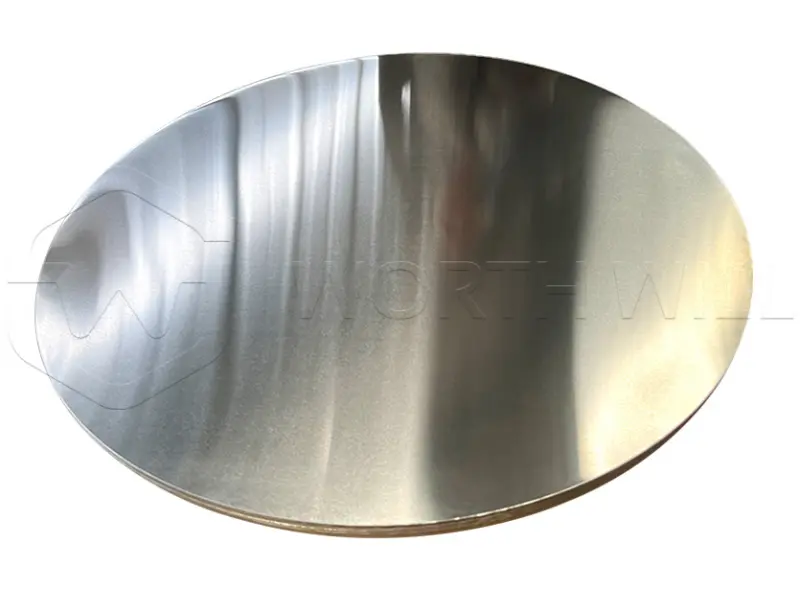
Deep drawing aluminum circles are primarily classified by their alloy, temper, and surface condition, which all impact their suitability for specific forming operations.
- By Alloy Type:
- 1050 Aluminum Circle: Best for maximum ductility.
- 1060 Aluminum Circle: Slightly higher purity, excellent formability.
- 1100 Aluminum Circle: Slightly stronger, good all-around performance for deep drawing.
- By Temper:
- “O” Temper (Annealed): This is the most common and preferred temper for deep drawing, as the material is in its softest, most ductile state, allowing for maximum deformation without cracking.
- “H” Tempers (e.g., H12, H14): These are strain-hardened tempers that offer increased strength. While possible to deep draw, they have reduced ductility compared to the “O” temper, limiting the severity of the draw.
- By Surface Finish:
- Mill Finish: The natural surface finish as it comes off the rolling mill. Suitable for many applications where the final product will be polished, coated, or hidden.
- Bright Finish: A smoother, more reflective surface often achieved through specific rolling processes, ideal for applications requiring a lustrous appearance.
- Other Finishes: Can include brushed or matte, depending on aesthetic requirements.
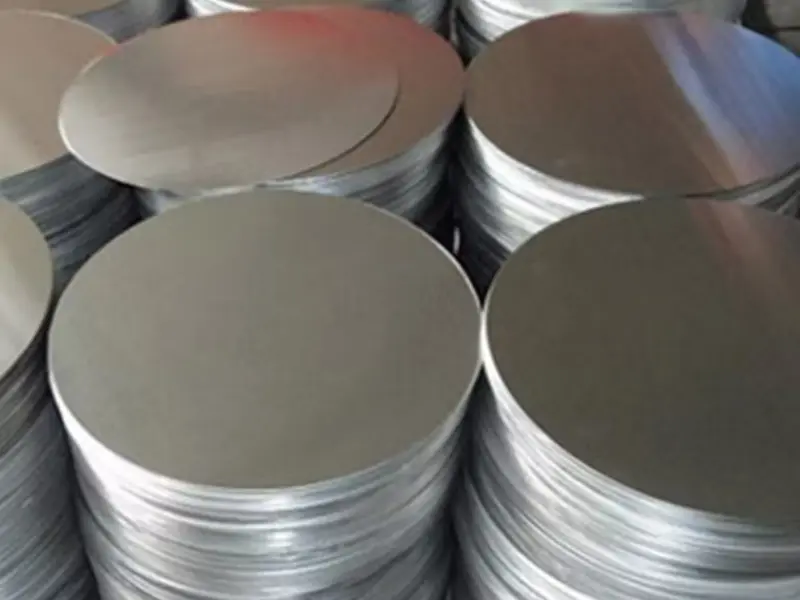
Thickness Options
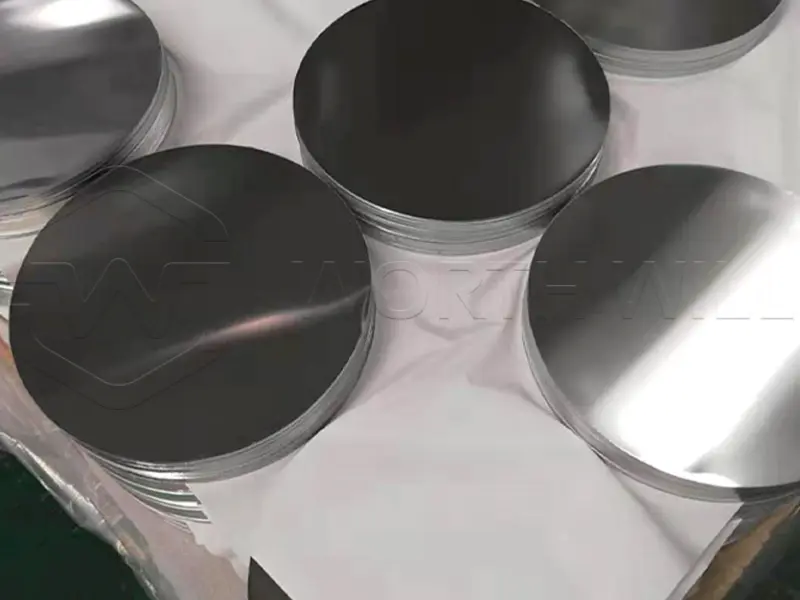
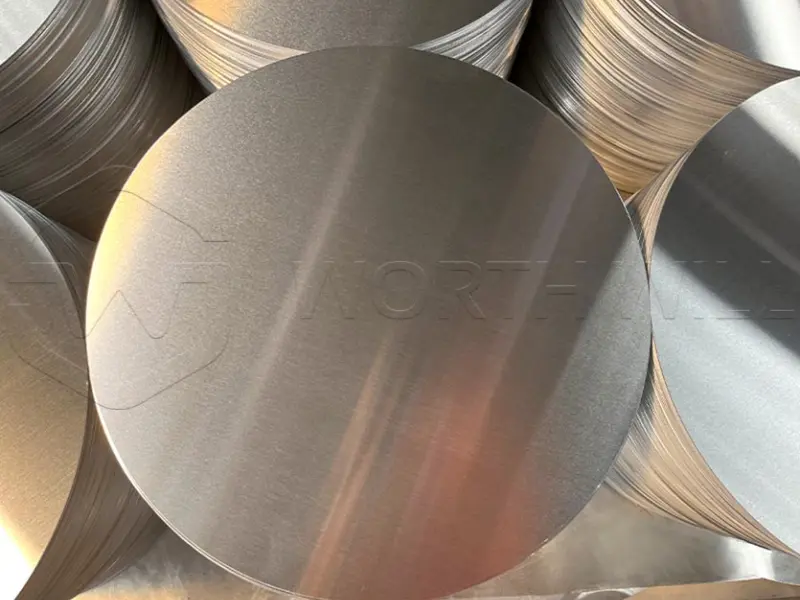
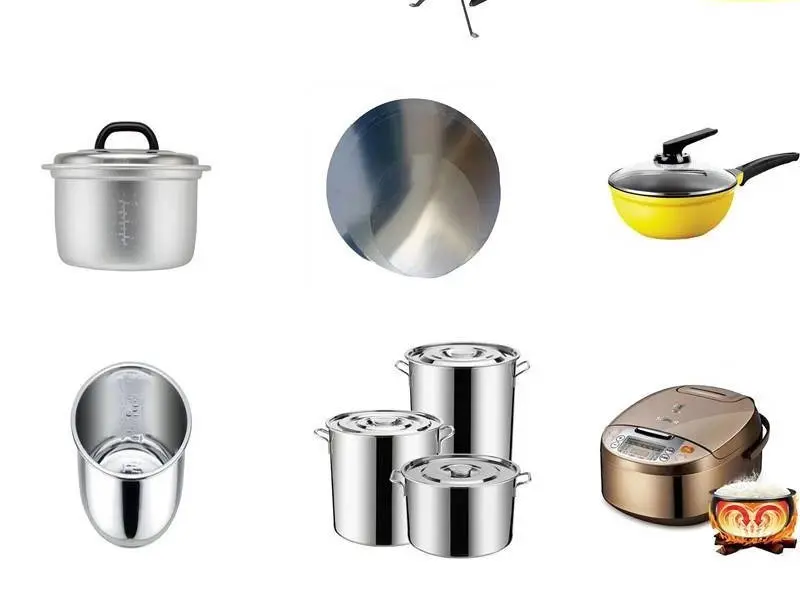
Deep drawing aluminum circles are supplied in different thicknesses to match various production needs.
Table 2: Thickness Range
| Thickness (mm) | Application Example |
|---|---|
| 0.4 – 0.8 | Lighting reflectors, kitchen lids |
| 0.9 – 1.5 | Small cookware, pans |
| 1.6 – 3.0 | Large pots, industrial parts |
| 3.1 – 6.0 | Heavy duty utensils |
Table 3: Alloy Comparison
| Alloy | Purity (%) | Strength | Ductility | Common Use |
|---|---|---|---|---|
| 1050 | 99.5 | Low | High | Cookware, lampshades |
| 1060 | 99.6 | Low | Very High | Pots, utensils, reflectors |
| 1100 | 99.0 | Medium | Good | Industrial, cookware |
Packaging of Aluminum Circles
To ensure safety during transportation, aluminum circles are packed carefully:
- Standard export wooden pallets
- Paper interleaved between circles
- Plastic film wrapping for moisture protection
- Metal strapping for secure handling
Table 4: Packaging Details
| Packaging Type | Details |
|---|---|
| Pallet Type | Wooden pallets, fumigation-free |
| Protection | Plastic film + kraft paper |
| Handling | Steel straps + corner protection |
| Export Standard | Suitable for sea and land transportation |
What is an Aluminum Circle?
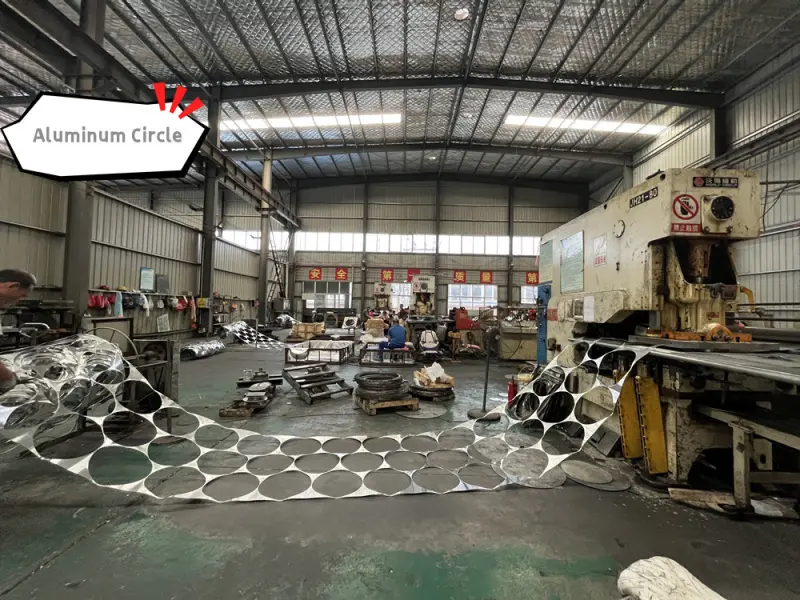
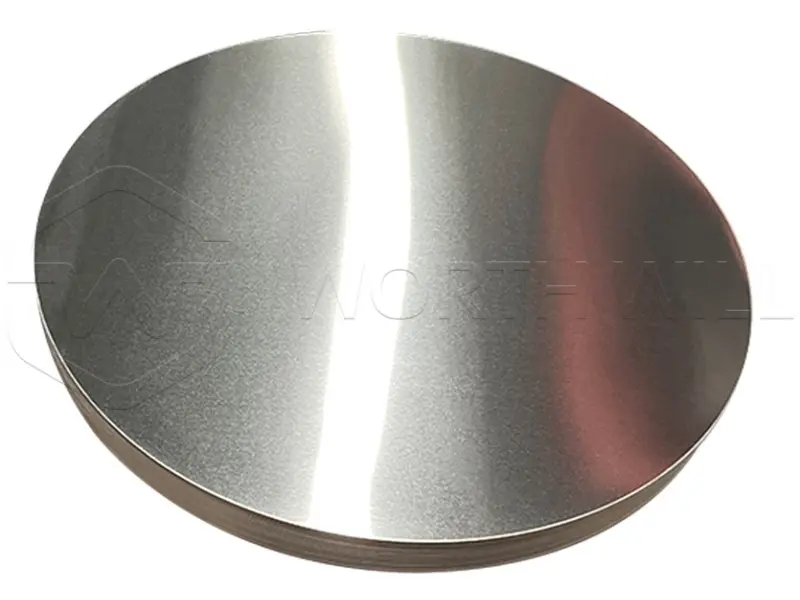
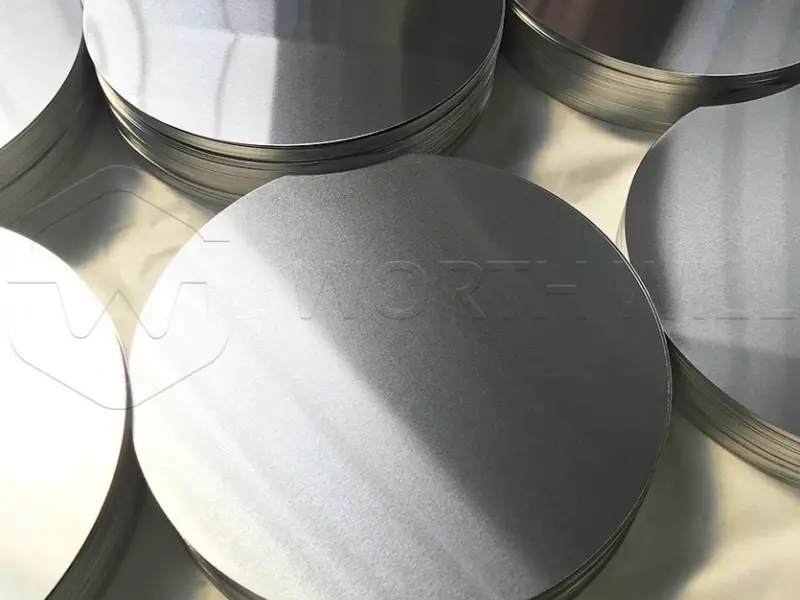
An aluminum circle is also called an aluminum disc or aluminum round blank. It is a flat, round metal plate stamped from aluminum coils or sheets.
Understanding the Basics of Aluminum Discs
We make these circles by placing high-quality aluminum coils into an automatic punching machine. The machine blanking process cuts the metal into perfect circles of different diameters. This process minimizes waste and saves time for factories that make round items.
Why Pure Aluminum is the Best Choice for Cookware
Our 1050, 1060, and 1100 aluminum circles belong to the 1000 series. This series is also known as pure aluminum.
- Excellent Heat Transfer: Pure aluminum conducts heat very quickly and evenly. This prevents hot spots in cooking pans.
- High Ductility: The metal is very soft in its annealed state. You can easily stretch, bend, or spin it without cracking.
- Corrosion Resistance: It naturally forms a protective oxide layer that resists rust and chemical wear.
- Eco-Friendly: Pure aluminum is 100% recyclable, which reduces manufacturing waste.
Full Specification Table of 1050 1060 1100 Aluminum Circles
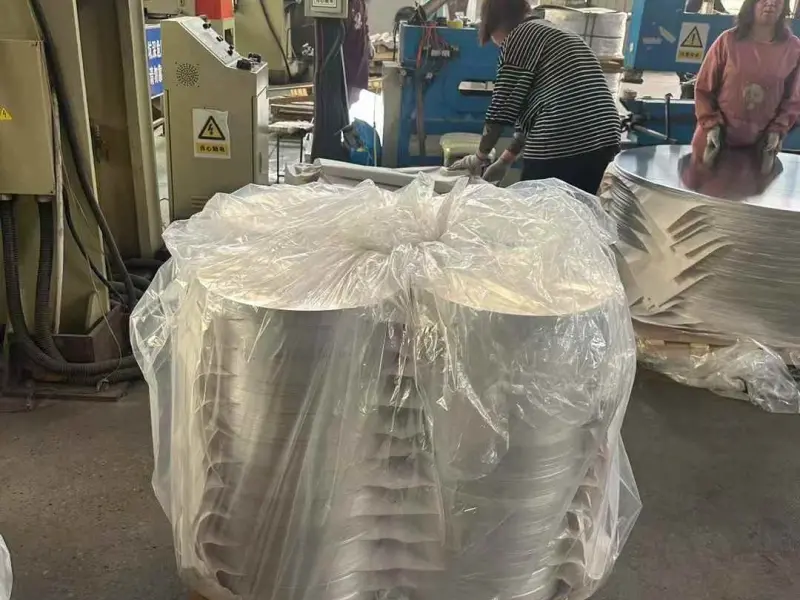
We supply a wide range of sizes and tempers to meet your exact needs. Below is the main technical parameter table for our aluminum discs.
Technical Parameter Details
| Specification Parameter | Available Range and Options |
|---|---|
| Alloy Types | 1050, 1060, 1100 |
| Temper (Hardness) | O, H12, H14, H16, H18, H22, H24, H26, H32 |
| Thickness Range | 0.3 mm to 10.0 mm |
| Diameter Range | 100 mm to 1500 mm |
| Surface Finish | Mill finish, bright, mirror, prepainted, embossed |
| Production Line | Continuous Casting (CC) and Direct Chill Casting (DC) |
| Quality Standard | ASTM B209, EN 485, GB/T 3880 |
| Protection | Interleaved with paper, PE film coating |
Mechanical Properties and Strength Analysis
The mechanical properties of the discs change based on the alloy and the temper state. Soft tempers have high elongation, while hard tempers have high tensile strength.
| Alloy and Temper | Tensile Strength (MPa) | Yield Strength (MPa) | Elongation (%) |
|---|---|---|---|
| 1050 – O | 60 – 95 | 20 – 45 | 30 – 45 |
| 1050 – H14 | 100 – 140 | 85 – 120 | 10 – 20 |
| 1060 – O | 55 – 90 | 15 – 40 | 35 – 45 |
| 1060 – H14 | 95 – 135 | 80 – 115 | 10 – 18 |
| 1100 – O | 75 – 110 | 25 – 55 | 25 – 40 |
| 1100 – H14 | 115 – 155 | 105 – 140 | 8 – 15 |
Alloy Comparison: 1050 vs 1060 vs 1100
Although these three alloys are very similar, they have small differences in chemical composition. These differences affect how they perform during production.
1050 Aluminum Circle Features
The 1050 aluminum circle contains at least 99.50% pure aluminum. It has the highest electrical and thermal conductivity of the three. It is very soft and is perfect for products that need maximum heat distribution, like electrical conductors or light reflectors.
1060 Aluminum Circle Features
The 1060 aluminum circle contains at least 99.60% aluminum. It offers an excellent balance between price and quality. It is highly ductile, making it the most popular choice for general cookware like frying pans, pots, and basins in Asian and African markets.
1100 Aluminum Circle Features
The 1100 aluminum circle has a slightly lower aluminum purity of 99.00%. It contains a small amount of copper (around 0.05% to 0.20%). This small addition makes the 1100 alloy stronger than 1050 and 1060. It is ideal for deep-drawn pots that must withstand high physical pressure during use.
Quick Comparison Table of Alloy Composition
| Alloy | Al % (Minimum) | Fe % (Maximum) | Si % (Maximum) | Cu % | Mn % |
|---|---|---|---|---|---|
| 1050 | 99.50% | 0.40% | 0.25% | 0.05% max | 0.05% max |
| 1060 | 99.60% | 0.35% | 0.25% | 0.05% max | 0.03% max |
| 1100 | 99.00% | 0.95% (Fe + Si) | 0.95% (Fe + Si) | 0.05% – 0.20% | 0.05% max |
Choosing the Right Temper (State of Hardness)
The temper of your aluminum disc determines how easy it is to shape. We offer several tempers from completely soft to fully hard.
The Soft Temper: O State
The O temper means the aluminum has been fully annealed (heated and slowly cooled). This makes the metal as soft and flexible as possible. It is the best temper for deep drawing and heavy metal spinning. If you make deep soup pots or pressure cookers, you must choose the O temper.
The Half-Hard Tempers: H14 and H24 States
The H14 and H24 tempers represent half-hard states. The metal has been work-hardened. It does not bend as easily as O temper, but it is much stronger. This is the ideal temper for shallow pans, flat traffic signs, and stamped license plates.
The Hard Tempers: H18 and H19 States
These tempers are fully hard. The aluminum circles are stiff and have high tensile strength. They do not stretch easily. They are used for flat panels, hard nameplates, and simple structural discs that will not undergo severe bending or stretching.
Temper Comparison Table
| Temper | Hardness Level | Recommended Forming Process | Best Applications |
|---|---|---|---|
| O | Extremely Soft | Deep drawing, spinning, hydroforming | High pots, kettles, pressure cookers |
| H12 / H22 | Quarter Hard | Light spinning, shallow stamping | Shallow pans, cosmetic containers |
| H14 / H24 | Half Hard | Standard bending, flat stamping | Frying pans, road signs, license plates |
| H16 / H26 | Three-Quarter Hard | Simple cutting, light bending | Nameplates, electronic covers |
| H18 | Fully Hard | Flat punching, minimal shaping | Heavy industrial discs, spacer plates |
Production Methods: CC Material vs. DC Material
There are two primary ways to produce aluminum circles. The casting method you choose will change the final quality of your products.
What is CC (Continuous Cast) Aluminum Circle?
CC material is made using a continuous caster. The liquid aluminum is cast directly into a thin sheet and cold-rolled into coils.
- Cost: Very economical.
- Properties: Lower elongation and slightly uneven grain structure.
- Best For: Simple metal spinning, shallow stamping, making light covers, and traffic signs. It may crack if you try to stretch it too deep.
What is DC (Direct Chill Cast) Aluminum Circle?
DC material is made by casting large ingots. These ingots are heated, hot-rolled first, and then cold-rolled into coils.
- Cost: Slightly higher than CC material.
- Properties: Extremely high elongation (usually over 30%), uniform grain structure, and excellent surface finish.
- Best For: Deep drawing cookware, high-end anodizing, and complex metal spinning. It will not crack during deep stretching.
How to Choose Between CC and DC for Your Factory
If you are making flat frying pans, traffic signs, or lampshades, you can save money by choosing CC material.
If you are making deep cooking pots, pressure cookers, or products that require a perfect mirror anodized finish, you must choose DC material.
| Feature | Continuous Casting (CC) | Direct Chill Casting (DC) |
|---|---|---|
| Rolling Type | Cold rolled directly | Hot rolled + Cold rolled |
| Elongation Rate | 15% to 25% | 30% to 42% |
| Orange Peel Risk | High if deep drawn | Extremely low |
| Anodizing Quality | Moderate | Excellent and uniform |
| Relative Price | Lower (Budget-friendly) | Premium (Slightly higher) |
Different Product Types of Aluminum Discs
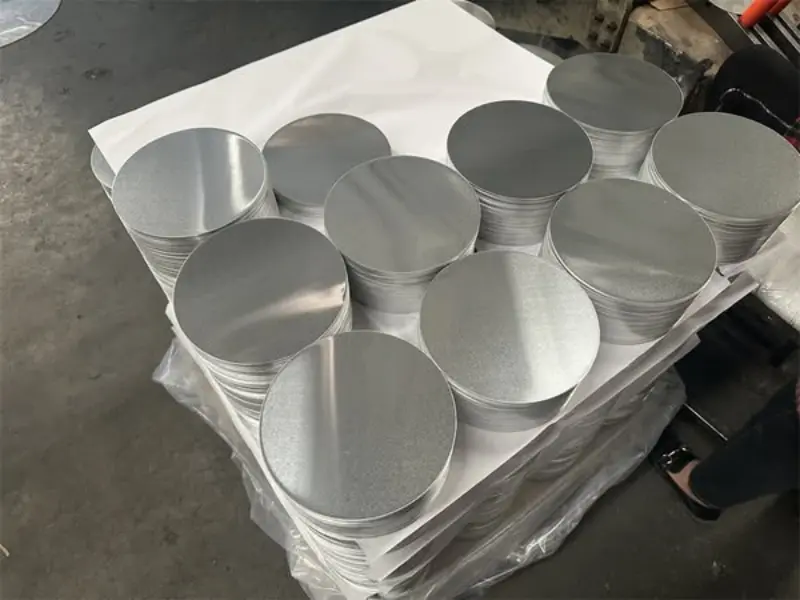

We do not just make standard mill-finish circles. We offer a wide range of specialized aluminum discs to suit different production methods and visual looks.
Deep Drawing Quality (DDQ) Aluminum Circles
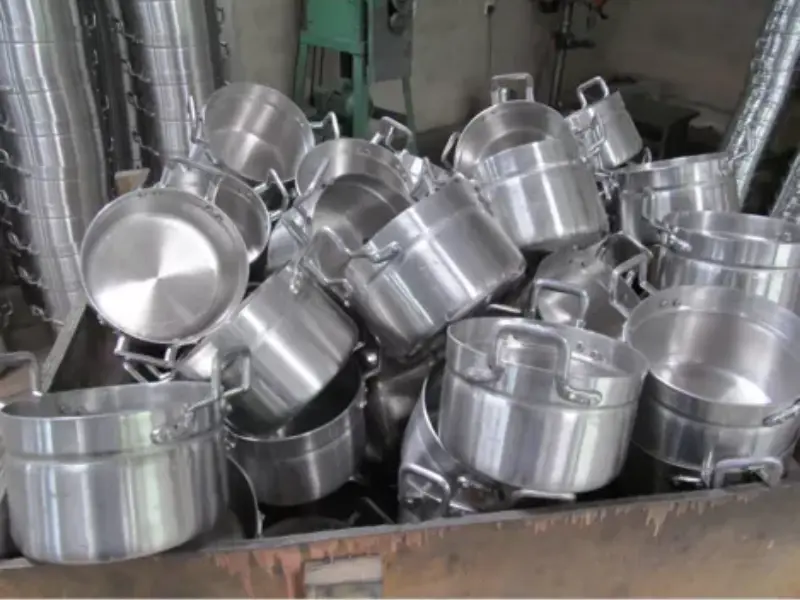
DDQ circles are specially processed to have very fine grain sizes. This prevents the “orange peel” effect (a rough, wrinkled surface) when the metal is stretched to its limits. They are perfect for making high pots, rice cooker bowls, and stainless-clad pans.
Spinning Quality Aluminum Circles
Spinning quality discs have balanced tensile strength and elongation. During metal spinning, a lathe spins the disc at high speed while a tool shapes it over a mold. Our discs flow smoothly over the mold, preventing tearing and saving labor time.
Prepainted and Non-Stick Coated Discs
To save time in your factory, we can supply prepainted aluminum circles. These come with a high-temperature non-stick coating (such as PTFE or ceramic) on one side, or protective paint on the other. You can stamp them directly into finished non-stick frying pans.
Mirror and Bright Finish Aluminum Circles
These circles undergo a special rolling and polishing process. They have a very high light reflectivity (often over 85%). They are highly popular in the lighting industry for making high-quality lamp reflectors and LED downlight covers.
Embossed Stucco Aluminum Discs
These circles feature a patterned, textured surface (such as a stucco or diamond pattern). The texture increases the surface area for better heat dispersion and adds skid resistance. They are often used for industrial heat shields, refrigerator linings, and decorative metal plates.
Applications of 1050, 1060, and 1100 Aluminum Circles
Because of their excellent properties, our aluminum discs are used in many different global industries.
                 ┌─────────────────────────────────────────┐
                  │ Aluminum Circle 1050 / 1060 / 1100      │
                  └────────────────────┬────────────────────┘
                                       │
         ┌─────────────────────────────┼─────────────────────────────┐
         ▼                             ▼                             ▼
┌─────────────────┐           ┌─────────────────┐           ┌─────────────────┐
│   Cookware &    │           │   Lighting &    │           │ Traffic Signs & │
│   Kitchenware   │           │   Reflectors    │           │  Road Safety    │
└─────────────────┘           └─────────────────┘           └─────────────────┘
Kitchenware and Cookware Products
This is the biggest market for aluminum circles. Manufacturers use them to make daily household items:
- Frying pans and saucepans: Usually made from 1.5 mm to 3.5 mm thick 1050 or 1060 H14 discs.
- Pressure cookers: Made from thick 1050 O temper discs to handle deep drawing and physical pressure.
- Kettles and teapots: Created using spinning-quality 1060 O temper discs.
- Non-stick pans: Made using prepainted or easy-to-coat 1100 O temper circles.
Lighting Equipment and Lamp Shades
Aluminum’s natural reflectivity and light weight make it perfect for lighting fixtures:
- High bay light reflectors: Made with mirror-finish 1050 or 1060 spinning discs.
- LED downlight housings: Stamped from thin 0.5 mm to 1.0 mm 1060 circles.
- Street light covers: Spun from durable 1100 H14 alloy discs to resist wind and rain.
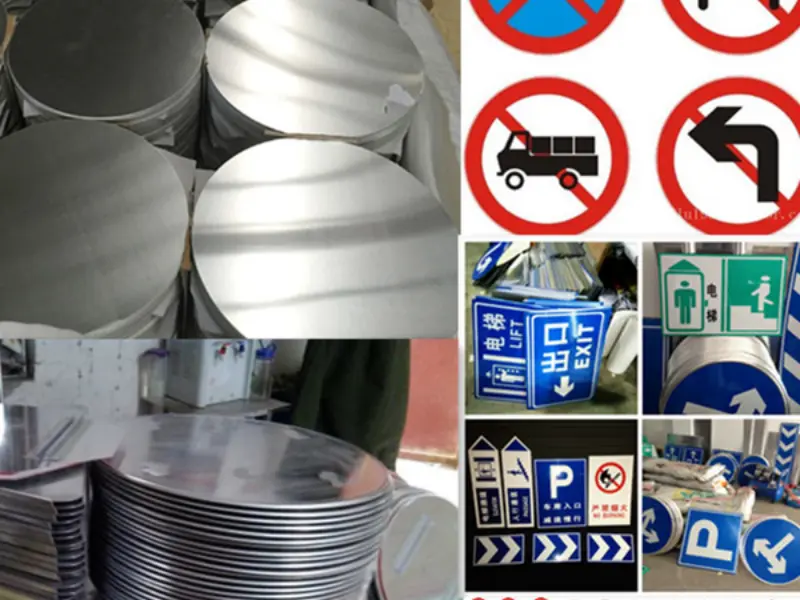
Road Signs and License Plates
Road safety products require flat, corrosion-resistant metals:
- Stop and warning signs: Made from thick, flat 1060 or 1100 H14 or H24 circles. They are easy to paint and reflect light well when covered with retroreflective vinyl.
- Vehicle license plates: Punched out of half-hard aluminum strips or small circular blanks.
Industrial Components and Heat Shields
Automotive and industrial companies use aluminum discs for temperature control and protection:
- Car heat shields: Embossed 1050 discs are shaped to protect car parts from exhaust heat.
- Capacitor shells: High-purity 1050 circles are impact-extruded into small capacitor cases.
- Industrial basins and tanks: Heavy-duty 1100 discs are welded to make chemical containers.

How We Calculate the Weight of Aluminum Circles
Calculating the exact weight of your order is important for shipping, logistics, and pricing. Aluminum has a standard density of 2.71 g/cm3 (which is equal to 0.00000271 kg/mm3).
The Standard Weight Calculation Formula
To find the weight of a single circular disc, we use the mathematical formula for the volume of a cylinder and multiply it by the density.
Let W be the weight of one aluminum circle in kilograms (kg).
Let D be the diameter of the circle in millimeters (mm).
For Let t be the thickness of the circle in millimeters (mm).
Let π be the mathematical constant approximately equal to 3.14159.
Let ρ be the density of aluminum, which is 2.71 g/cm3.
The formula is written as:
W=4×1,000,000π×D2×t×2.71
We can simplify this formula for quick daily calculations. The simplified equation is:
W=D2×t×0.0000021285
Practical Weight Calculation Example
Let us calculate the weight of a single aluminum circle with a diameter D=400 mm and a thickness t=2.0 mm.
Using our formula:
W=4,000,0003.14159×4002×2.0×2.71
First, calculate the square of the diameter:
4002=160,000 mm2
Next, multiply the numbers in the numerator:
3.14159×160,000×2.0×2.71=2,723,858.176
Now, divide by 4,000,000:
W=4,000,0002,723,858.176≈0.681 kg
Each aluminum circle in this size weighs approximately 0.681 kg. If your order has 10,000 pieces, the total net weight will be around 6,810 kg.
Quality Standards and Inspection Process
We maintain strict quality control standards. We want every shipment to arrive in perfect condition, with no defects to slow down your manufacturing.
Surface Inspection and Anti-Scratch Protection

Pure aluminum scratches very easily because it is soft. We prevent scratches using two main methods:
- Paper Interleaving: We place a thin sheet of neutral paper between every single aluminum disc.
- PE Film Protection: We can apply a peelable plastic film on one side of the circle to protect the metal during shipping and stamping.
- No Oil Stains: Our machines use food-grade lubricant oil that leaves no heavy dark stains on the metal.
Dimension Tolerances and Thickness Control
Our stamping molds are calibrated regularly to keep very tight tolerances.
- Thickness Tolerance: We keep thickness variations within ±0.02 mm.
- Diameter Tolerance: We keep diameter variations within ±0.5 mm.
- Perfect Roundness: Our circles are perfectly round with clean, burr-free edges. This prevents cut fingers and keeps your stamping molds safe from damage.
Testing Grain Size to Avoid Orange Peel Effect

The “orange peel” defect happens when the aluminum grain size is too large. During stretching, the large grains slip and create a rough surface like an orange skin.
We perform microscopic grain size tests before blanking. We ensure the grain size remains uniform and small (usually ASTM standard 6 or finer) so your finished pots remain perfectly smooth.
Safe Packing and International Shipping
Aluminum can easily oxidize (rust) if it comes into contact with moisture during ocean transit. Our packaging is designed to keep water out completely.
┌────────────────────────────────────────────────────────┐
│               WOODEN PALLET BASE                       │
├────────────────────────────────────────────────────────┤
│ 1. Bottom Desiccant (Moisture Absorber)                │
│ 2. Plastic Film Wrap (Waterproof Barrier)              │
│ 3. Corrugated Cardboard Cover                          │
│ 4. Aluminum Circles with Paper Interleaving            │
│ 5. Steel Strapping (Secure Bundle)                     │
└────────────────────────────────────────────────────────┘
Eye to Sky vs. Eye to Wall Packing Methods
We offer two professional ways to stack your aluminum circles on pallets:
- Eye to Sky: The circles are stacked flat on the pallet, with the core hole or pile pointing up toward the sky. This is the most stable and popular method.
- Eye to Wall (Horizontal): The circles are stacked on their edges, facing sideways like a wall. This is useful for certain factory lifting equipment.
Moisture Protection and Wooden Pallets
Our packaging process follows five strong steps:
- We place the circle stack on a strong, fumigated wooden pallet.
- We place gel desiccant bags around the aluminum stack to absorb humidity.
- We wrap the entire stack tightly in multiple layers of waterproof plastic film.
- We cover the top and sides with thick, protective corrugated cardboard.
- We secure the packaging bundle with strong steel bands to prevent shifting inside shipping containers.
Applications of 1050 1060 1100 Aluminum Circle
Aluminum circles are widely used in many industries.
- Cookware: Pots, pans, frying utensils, pressure cookers
- Lighting: Lamp covers, reflectors
- Signage: Traffic signs, road safety boards
- Industrial Use: Filter housings, automotive parts
- Decorative: Household items, artistic panels
Advantages of 1050 1060 1100 Aluminum Circle
- Smooth and bright surface
- Excellent formability and elongation
- Good corrosion resistance
- Lightweight yet durable
- Suitable for anodizing and polishing
Advantages of Using 1050/1060/1100 Alloys
✅ Excellent Formability: Can be drawn to extreme depths without cracking
✅ Good Surface Quality: Smooth finish reduces post-processing needs
✅ Corrosion Resistance: Natural oxide layer protects against oxidation
✅ High Thermal Conductivity: Ideal for heat-related applications
✅ Non-Toxic Properties: Safe for food contact applications
✅ Recyclability: Environmentally friendly and sustainable
Technical Specifications Table
| Specification | 1050 | 1060 | 1100 | Testing Standard |
|---|---|---|---|---|
| Aluminum Content | 99.50% min | 99.60% min | 99.00% min | ASTM B209 |
| Iron Content | 0.40% max | 0.35% max | 0.95% max | ASTM B209 |
| Silicon Content | 0.25% max | 0.25% max | 0.95% max | ASTM B209 |
| Hardness (HV) | 20-30 | 20-30 | 25-35 | ASTM E10 |
Deep Drawing Process Parameters
| Parameter | Recommended Range | Effect on Drawing |
|---|---|---|
| Drawing Speed | 50-200 mm/sec | Higher speed = higher productivity |
| Blank Holder Force | 10-50 kN | Prevents wrinkling |
| Lubrication | Oil-based lubricants | Reduces friction and tearing |
| Die Radius | 4-8 × material thickness | Precessive tearing |
Quality Control Measures
- Dimensional Checks:
- Diameter tolerance: ±0.1mm
- Thickness tolerance: ±0.05mm
- Flatness: ≤0.5mm/300mm
- Surface Quality:
- No visible defects
- Smooth surface finish
- Uniform appearance
- Mechanical Properties:
- Tensile strength verification
- Elongation testing
- Hardness testing
Comparison with Alternative Materials
| Feature | Aluminum 1050-1100 | Stainless Steel | Copper |
|---|---|---|---|
| Formability | Excellent | Good | Excellent |
| Cost | Low | High | Very High |
| Weight | Light | Heavy | Heavy |
| Corrosion Resistance | Good | Excellent | Good |
| Thermal Conductivity | Excellent | Poor | Excellent |
Industry Standards & Certifications
FDA Approval: For food contact applications
ASTM B209: Standard specification for aluminum sheet
ISO 9001: Quality management system
RoHS Compliance: Restriction of hazardous substances
Frequently Asked Questions
What is the main difference between 1050 and 1060 aluminum circles?
The primary difference is the purity of the aluminum. 1050 aluminum contains at least 99.50% pure aluminum, while 1060 contains 99.60%. In practical use, their mechanical properties are almost identical. However, 1050 is slightly better for electrical conductivity, while 1060 is more common for budget-friendly cookware.
Why do my aluminum circles crack when making deep pots?
If your discs crack during deep drawing, it is usually because you are using CC (Continuous Cast) material instead of DC (Direct Chill Cast) material, or your temper is too hard. For deep pots, you must use DC material with O temper (fully soft). This provides the highest elongation (over 30%), allowing the metal to stretch deep without tearing.
What thickness is best for induction bottom cookware?
For standard cookware, a thickness between 1.5 mm and 3.0 mm is ideal. If you are welding or pressing a magnetic steel plate to the bottom for induction cooktops, we recommend using at least a 2.5 mm or 3.0 mm thick 1050 or 1060 aluminum disc. This thickness prevents the bottom of the pan from warping when heated.
How do you protect the surface of aluminum circles during shipping?
We pack our circles using paper interleaving. This means we place a sheet of thin, acid-free paper between every single circle to prevent metal-on-metal rubbing. For high-end applications like mirror-finish or prepainted circles, we can also apply a protective PE plastic film on the face of the metal.
What is the lead time for custom-sized aluminum discs?
For standard sizes (such as diameters of 200 mm, 300 mm, or 400 mm), we have stock molds and can deliver within 15 to 25 days. For custom sizes that require us to build a new stamping mold, the production lead time is typically between 30 and 40 days.
- 4×8 Aluminum Sheet Near Me
- 20mm Aluminium Plate
- Household Foil vs. Industrial Aluminium Foil
- Aluminium Foil vs. Aluminium Sheet and Strip
- Aluminium Foil Price per kg