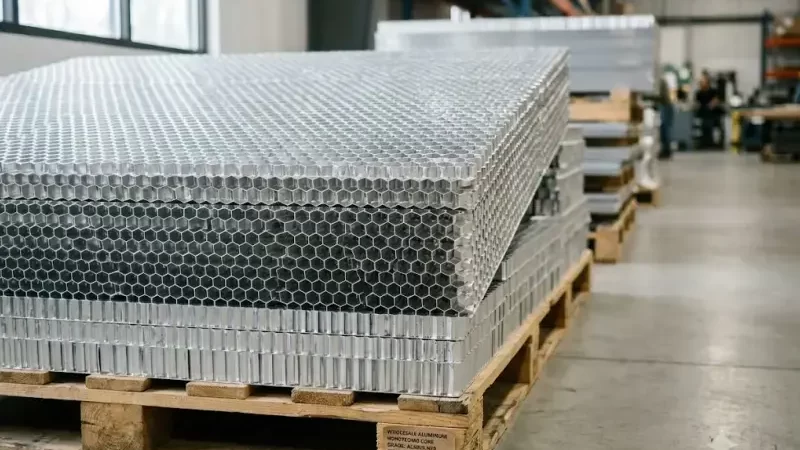
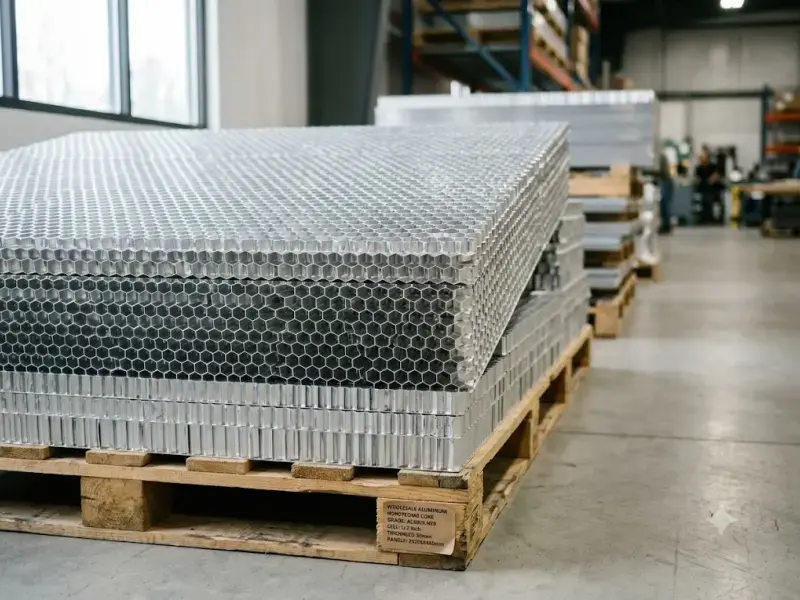
Wholesale Aluminum Honeycomb Core is one of the most efficient structural materials available.
Its hexagonal cell structure gives exceptional stiffness and strength relative to its weight.
Used in aerospace panels, curtain wall cladding, cleanroom floors, ship decks, and furniture, it solves the problem of needing rigidity without adding mass.
Why Honeycomb Core Outperforms Solid Materials
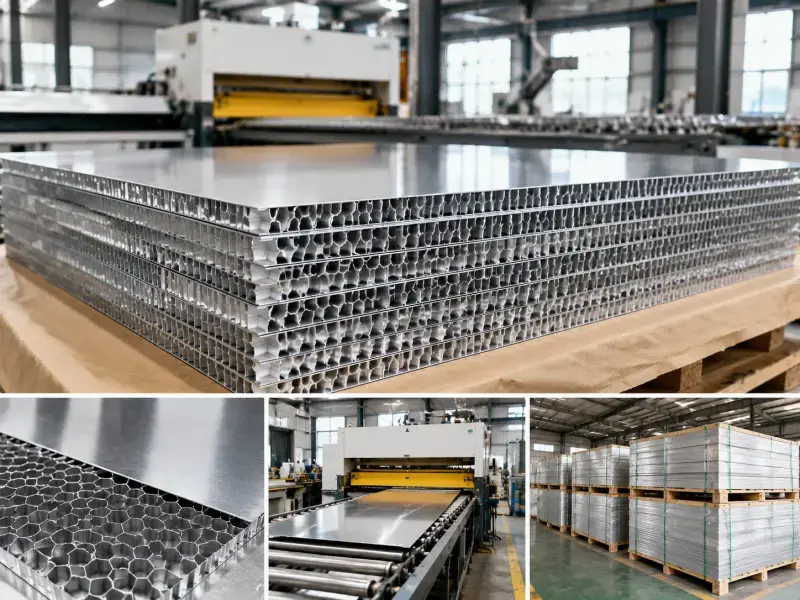
The honeycomb geometry is nature’s most efficient structure. When bonded between two face sheets, the core transfers load between faces through a network of thin-walled cells. This creates a sandwich panel that behaves like a deep I-beam — high moment of inertia, very low weight.
Structural Efficiency — Numbers That Show the Advantage
| Configuration | Relative Weight | Relative Stiffness | Relative Strength |
|---|---|---|---|
| Solid aluminum plate | 100% | 100% | 100% |
| Standard sandwich (10mm core) | ~3–5% | ~700% | ~350% |
| Honeycomb sandwich (25mm core) | ~4–6% | ~3,500% | ~900% |
A 25mm aluminum honeycomb sandwich panel can be 35 times stiffer than a solid aluminum sheet of the same total weight. That is the core reason aerospace, architecture, and transportation industries specify it.
Four Properties That Make It Practical
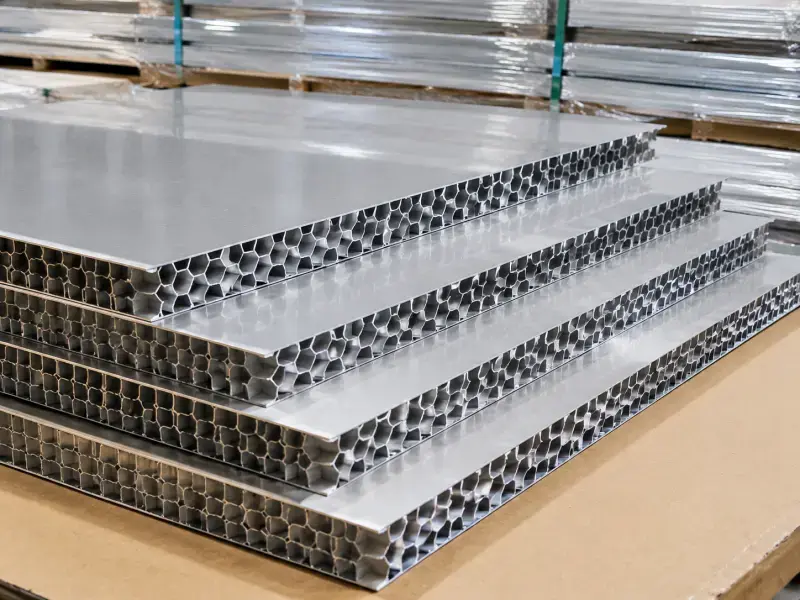
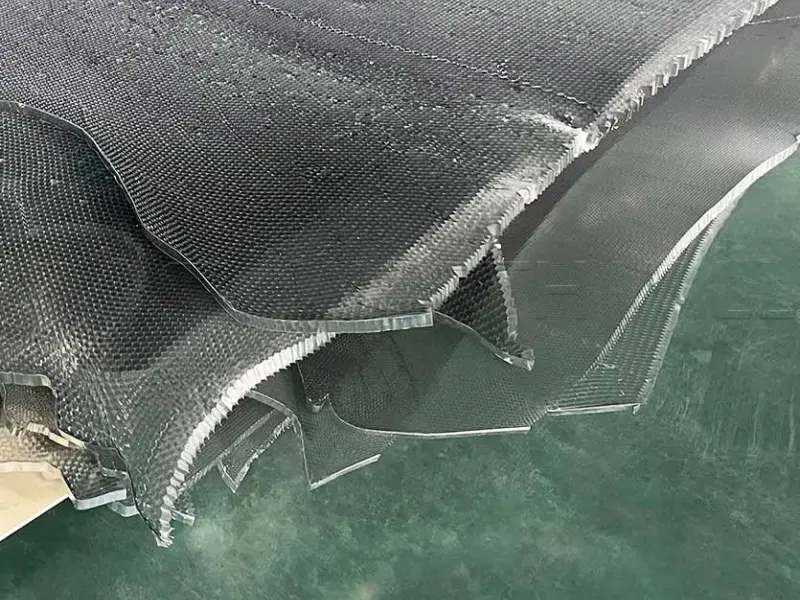
→ Weight: 3–50 kg/m³ core density — the lightest structural options available → Flatness: bonded panels stay flat because the core resists face sheet buckling → Thermal insulation: the air-filled cells give moderate insulation properties → Sound damping: the cell structure absorbs vibrational energy
How Aluminum Honeycomb Core Is Made
The Manufacturing Process
| Step | Process | Detail |
|---|---|---|
| Foil preparation | Roll aluminum foil to target thickness | 0.03mm–0.10mm typical |
| Adhesive application | Apply node bonding adhesive in stripes | Stripe spacing = cell size × 0.866 |
| Stack bonding | Stack foil sheets and bond at node points | Heat and pressure cure |
| Block expansion | Expand the bonded block to open cells | Manual or mechanical expansion |
| Block slicing | Slice expanded block to required core height | Core height = panel thickness – face sheets |
| Surface treatment | Phosphoric acid anodize or chromate | Improves adhesive bonding |
The key variable is expansion ratio. Expanding the bonded foil block to different widths gives different cell sizes. A tighter expansion gives smaller, denser cells; a wider expansion gives larger, lighter cells.
Cell Size Options — The First Spec to Decide
Cell size is the diagonal dimension of one hexagonal cell. It directly determines the core density, strength, and the minimum face sheet thickness that can be used without dimpling.
Standard Cell Sizes and Their Properties
| Cell Size | Density Range (kg/m³) | Compressive Strength | Best Application |
|---|---|---|---|
| 3.2mm (1/8″) | 60–130 | Very High | Aerospace, floor panels |
| 4.8mm (3/16″) | 40–90 | High | Aerospace, structural panels |
| 6.4mm (1/4″) | 25–65 | Medium-High | Architecture, transport |
| 9.5mm (3/8″) | 15–40 | Medium | Interior panels, furniture |
| 12.7mm (1/2″) | 10–25 | Moderate | Lightweight interior |
| 19.1mm (3/4″) | 6–16 | Light | Non-structural, decorative |
| 25.4mm (1″) | 4–10 | Very Light | Acoustic, very light panels |
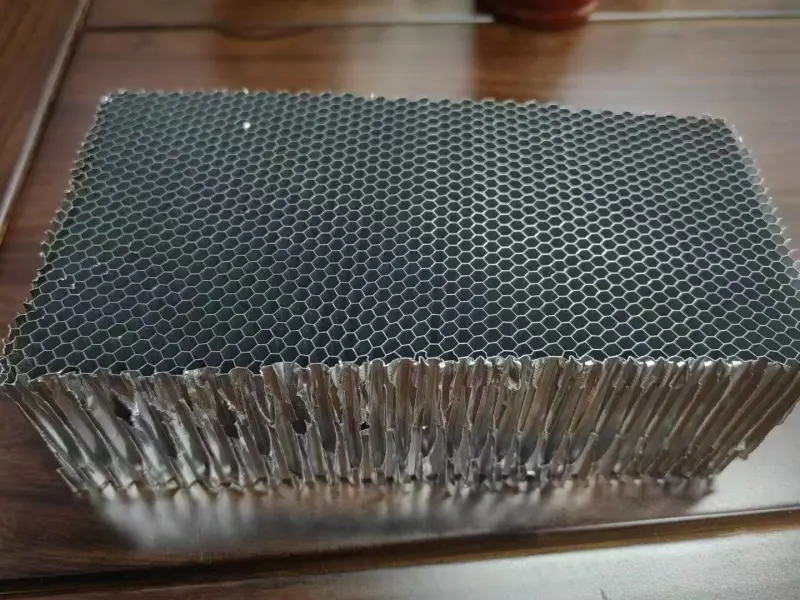
Smaller cells give denser, stronger core but heavier panels. Larger cells give lighter core but lower load capacity. For structural floor panels and aerospace applications, 3.2mm–6.4mm is standard. For interior cladding and furniture, 9.5mm–19.1mm gives sufficient performance at lower weight and cost.
How Cell Size Affects Face Sheet Minimum Thickness
Larger cells require thicker face sheets to prevent face sheet dimpling under load. A rough guide:
| Cell Size | Minimum Face Sheet (Aluminium) |
|---|---|
| 3.2mm | 0.3mm |
| 6.4mm | 0.5mm |
| 9.5mm | 0.8mm |
| 12.7mm | 1.0mm |
| 19.1mm | 1.5mm |
Foil Thickness and Core Density — The Two Numbers That Define Performance
Foil Thickness Options
The foil used to make the honeycomb determines both density and strength. Thicker foil = denser, stronger, heavier core.
| Foil Thickness | Core Density (6.4mm cell) | Compressive Strength | Use |
|---|---|---|---|
| 0.03mm | ~16 kg/m³ | ~1.0 MPa | Very light interior panels |
| 0.04mm | ~22 kg/m³ | ~1.8 MPa | Light structural |
| 0.05mm | ~29 kg/m³ | ~2.8 MPa | General structural |
| 0.06mm | ~35 kg/m³ | ~3.8 MPa | Heavy structural |
| 0.08mm | ~46 kg/m³ | ~6.0 MPa | Aerospace, floor panels |
| 0.10mm | ~58 kg/m³ | ~8.5 MPa | High-load aerospace |
Core Density Guide by Application
| Density (kg/m³) | Typical Use | Strength Level |
|---|---|---|
| 4–10 | Decorative panels, acoustic ceiling | Very light duty |
| 10–20 | Interior cladding, furniture, door panels | Light duty |
| 20–40 | Architecture, partitions, transport interior | Medium duty |
| 40–70 | Marine decks, cleanroom floors, vehicle panels | Heavy duty |
| 70–130 | Aerospace primary structure, floor panels | Very heavy duty |
Alloys Used in Wholesale Aluminum Honeycomb Core
3003 Alloy Wholesale Aluminum Honeycomb Core— The General Purpose Core
3003-H18 or 3003-H19 is the most widely used alloy for commercial and architectural honeycomb core. Manganese addition gives good strength at the foil thicknesses used in core manufacture. It anodizes reasonably well and bonds cleanly with standard adhesives.
Best for: architectural panels, interior partitions, furniture core, transportation panels
| Property | 3003-H18 |
|---|---|
| Tensile strength (foil) | ~200 MPa |
| Elongation | ~1–3% |
| Corrosion resistance | Good |
| Cost level | Lowest |
5052 Alloy Wholesale Aluminum Honeycomb Core— Higher Strength, Corrosion Resistant
5052-H19 gives significantly higher tensile strength than 3003 at the same foil thickness. Marine and outdoor applications specify 5052 because of its excellent corrosion resistance in saltwater and humid environments.
Best for: marine vessel decking, offshore structures, humid environment panels, boat interiors
| Property | 5052-H19 |
|---|---|
| Tensile strength (foil) | ~280 MPa |
| Elongation | ~1–2% |
| Corrosion resistance | Excellent |
| Cost level | +15–25% vs 3003 |
5056 Alloy Wholesale Aluminum Honeycomb Core— High-Strength Core
5056 gives the highest strength among common honeycomb alloys. Specified for aerospace floor panels, military applications, and high-load structural panels where every kilogram of mass matters.
Best for: aerospace floor panels, military equipment, high-load structural core
2024 and 7075 Alloys — Aerospace Premium Core
These heat-treatable alloys are used in aerospace primary structure where strength-to-weight ratio is critical. 2024-T3 and 7075-T6 honeycomb core meets aerospace specifications including AMS 2461 and MIL-C-7438.
Best for: aircraft fuselage panels, helicopter rotor blades, satellite structures
Alloy Comparison Summary
| Alloy | Foil Temper | Strength Level | Corrosion Resistance | Cost | Primary Use |
|---|---|---|---|---|---|
| 3003 | H18/H19 | Medium | Good | Lowest | Architecture, interior |
| 5052 | H19 | High | Excellent | Medium | Marine, outdoor |
| 5056 | H19 | Very High | Good | Higher | Aerospace, military |
| 2024 | T3 | Very High | Moderate | Highest | Aerospace primary |
| 7075 | T6 | Highest | Moderate | Highest | High-performance aerospace |
Product Types — What Form the Core Takes
Unexpanded Block (HOBE — Honeycomb Before Expansion)
The bonded stack of foil before expansion. Shipped in compact block form. The buyer expands it to the required cell size and cuts to height. HOBE is the most cost-efficient form for high-volume buyers who have expansion capability.
Advantages: lowest shipping cost per panel, buyer controls cell size and block dimensions Used by: panel fabricators, large construction projects, aerospace manufacturers
Expanded and Sliced Core
The expanded block sliced to the required core height. Ready to bond between face sheets. The most common form for panel fabricators who do not have expansion equipment.
Available heights: typically 5mm to 300mm in standard increments Common height increments: 5mm, 6mm, 8mm, 10mm, 12mm, 15mm, 20mm, 25mm, 30mm, 50mm
Overexpanded Core (OX Core)
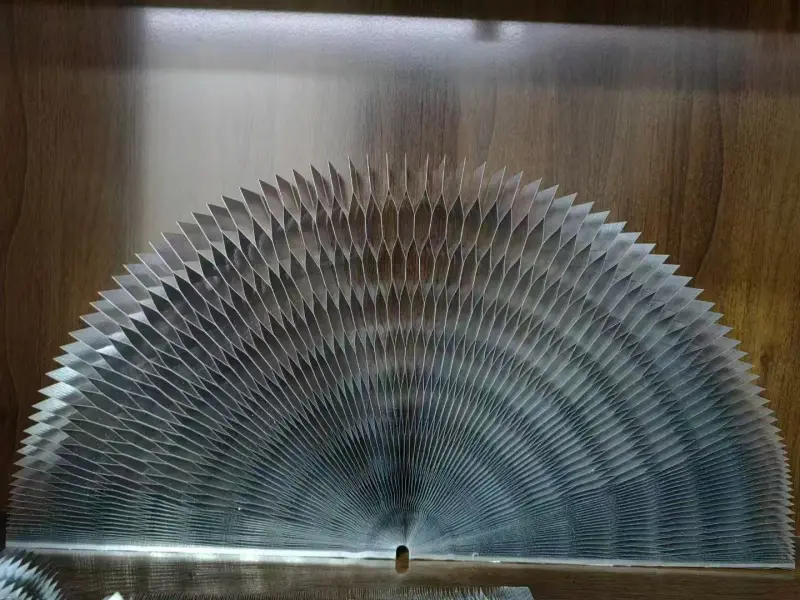
Standard hexagonal cells are symmetric. Overexpanded core has cells stretched in one direction — creating a rectangular cell rather than a hexagonal one. This allows the core to form curved shapes without wrinkling.
Used for: curved architectural panels, boat hull inner panels, curved facade panels
Double Flex Core (Flex Core)
Cells are cut and arranged to allow bending in two directions simultaneously. Used for compound-curved panels — curved in both length and width at the same time.
Used for: complex curved aerospace components, curved automotive body panels
Perforated Core
Holes are punched through the cell walls to allow air and resin to flow through during panel fabrication. Essential for vacuum infusion and resin transfer molding (RTM) composite manufacturing.
Used for: composite panel manufacturing, resin-infused aerospace structures
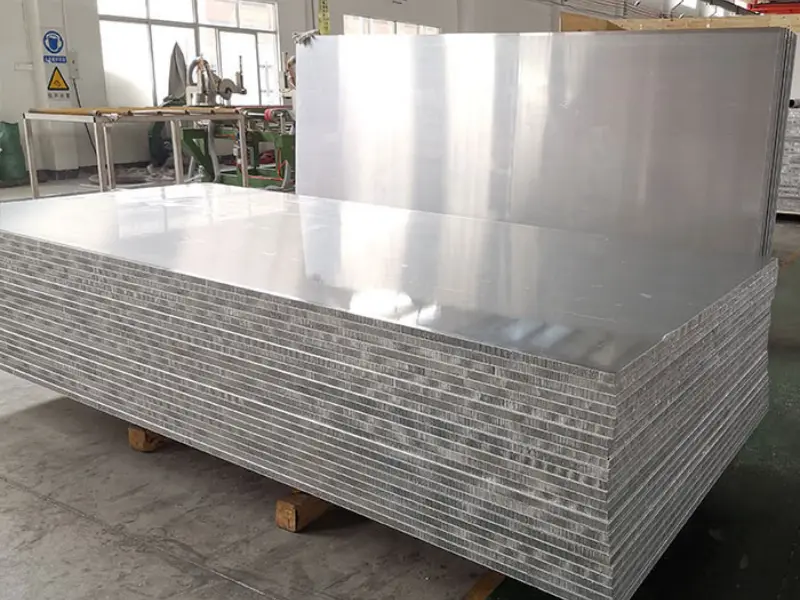
Product Type Comparison
| Core Type | Cell Shape | Curvature | Best Application |
|---|---|---|---|
| Standard expanded | Hexagonal | Flat panels only | Architecture, transport |
| HOBE unexpanded | N/A | Flat | Volume buyers with expansion equipment |
| Overexpanded (OX) | Rectangular | Single curve | Curved facades, boat hulls |
| Double flex | Irregular | Compound curve | Aerospace, complex shapes |
| Perforated | Hexagonal + holes | Flat | Composite manufacturing |
Aluminum Honeycomb Core vs Other Core Materials
Aluminum Honeycomb vs Nomex (Aramid) Honeycomb
| Feature | Aluminum Honeycomb | Nomex Honeycomb |
|---|---|---|
| Density range | 16–130 kg/m³ | 24–96 kg/m³ |
| Compressive strength | Higher | Good |
| Thermal conductivity | Higher | Lower |
| Fire resistance | Melts at 660°C | Chars, does not melt |
| Moisture absorption | None | Some |
| Cost | Lower | Higher (3–5×) |
| Main use | Architecture, transport | Aerospace primary structure |
For most commercial applications, aluminum honeycomb is the correct choice. Nomex is specified where fire resistance or radar transparency is required.
Aluminum Honeycomb vs Paper Honeycomb
| Feature | Aluminum Honeycomb | Paper Honeycomb |
|---|---|---|
| Compressive strength | Much higher | Low |
| Moisture resistance | Excellent | Poor |
| Outdoor use | Yes | No |
| Weight | Light | Very light |
| Cost | Higher | Lowest |
| Applications | Structural, exterior | Packaging, interior doors only |
Aluminum Honeycomb vs Foam Core (PVC, PU)
| Feature | Aluminum Honeycomb | Foam Core |
|---|---|---|
| Compressive strength | Higher | Moderate |
| Density at same strength | Lower | Higher |
| Thermal insulation | Lower | Better |
| Shear strength | Higher | Lower |
| Bonding surface | Good | Good |
| Cost | Higher | Lower |
| Best use | High-strength panels | Insulation-critical panels |
Wholesale Price Reference — Aluminum Honeycomb Core
Core Price by Alloy and Cell Size (2024–2025, Factory Direct)
| Alloy | Cell Size | Foil Thickness | Density | Price /m² (50mm height) |
|---|---|---|---|---|
| 3003-H18 | 9.5mm | 0.04mm | ~20 kg/m³ | USD 8–15 |
| 3003-H18 | 6.4mm | 0.05mm | ~30 kg/m³ | USD 12–20 |
| 3003-H18 | 6.4mm | 0.08mm | ~46 kg/m³ | USD 18–30 |
| 5052-H19 | 6.4mm | 0.05mm | ~32 kg/m³ | USD 15–25 |
| 5052-H19 | 4.8mm | 0.06mm | ~45 kg/m³ | USD 20–35 |
| 5056-H19 | 4.8mm | 0.06mm | ~47 kg/m³ | USD 28–45 |
Factors That Move the Price
→ Alloy: 5052 costs 15–25% more than 3003. 5056 adds 30–50%. → Cell size: smaller cells are more expensive per m² at the same density → Core height: taller cores cost more per m² but less per m³ → Surface treatment: phosphoric acid anodize adds USD 2–5/m² → HOBE vs expanded: HOBE is cheaper per unit volume due to lower shipping cost → Order volume: orders above 500 m² unlock better pricing
How to Specify Wholesale Aluminum Honeycomb Core
Complete Specification Checklist
| Parameter | What to Specify | Example |
|---|---|---|
| Alloy | Foil alloy grade | 3003 or 5052 |
| Cell size | Diagonal dimension | 6.4mm |
| Foil thickness | In mm | 0.05mm |
| Core density | kg/m³ | ~29 kg/m³ |
| Core height | In mm | 25mm |
| Sheet size | Length × Width | 2440 × 1220mm |
| Surface treatment | Anodize / chromate / plain | Phosphoric acid anodize |
| Form | Expanded / HOBE | Expanded and sliced |
| Standard | AMS, ASTM, or EN | ASTM C-2461 |
| Quantity | m² or sheets | 500 m² |
Applications Across Industries
Aerospace and Aviation
- Aircraft fuselage and wing secondary panels
- Floor panels in commercial and business aircraft
- Overhead bin doors and interior cabin panels
- Helicopter fuselage and rotor blade components
- Satellite solar array substrate
- Drone and UAV structural panels
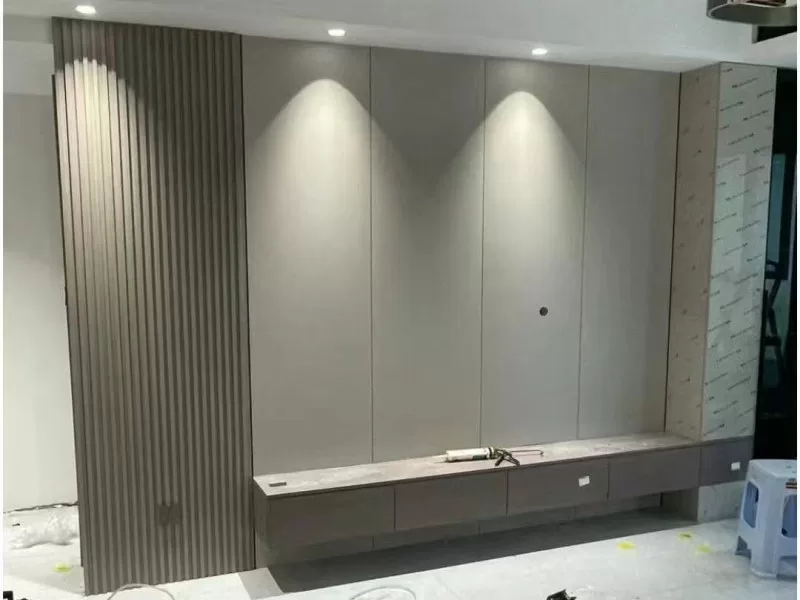
Architecture and Curtain Wall
- Aluminum composite curtain wall panels (ACP with honeycomb core)
- Building facade cladding panels — lighter than solid aluminum
- Elevator cab interior wall and ceiling panels
- Cleanroom wall panels with flush surface requirements
- Partition wall panels in modular buildings
- Suspended ceiling panels in large span applications
Marine and Offshore
- Vessel deck plating (5052 core for saltwater resistance)
- Bulkhead and interior wall panels on commercial ships
- Helicopter landing pad decking
- Offshore platform grating and flooring
- Yacht interior panel and furniture substrate
Transportation
- High-speed train interior wall and ceiling panels
- Bus and coach interior cladding
- Truck body sidewalls (reduces vehicle weight)
- Racing car body panels and floor panels
- EV battery housing structural panels
Industrial and Clean Technology
- Cleanroom raised access floor panels
- Semiconductor equipment table surfaces
- Optical table substrate (vibration damping)
- Solar panel mounting structure substrate
- Industrial shelving and rack panels requiring low weight
Furniture and Interior Design
Custom exhibition and display structures
Door cores for flush doors (lightweight)
Table tops for exhibition and event furniture
Retail display stand panels
Partition systems in office interiors
Frequently Asked Questions
What Is the Most Common Alloy for Wholesale Aluminum Honeycomb Core
3003-H18 or 3003-H19 is the most widely ordered alloy for commercial, architectural, and transportation applications. It offers a good balance of strength, corrosion resistance, and cost. For marine and offshore applications, 5052-H19 is specified for its saltwater corrosion resistance. Aerospace applications typically use 5056-H19, 2024-T3, or 7075 depending on the structural requirement.
What Cell Size Should I Choose for a Floor Panel Application
For floor panels in commercial or industrial applications, 6.4mm (1/4 inch) or 4.8mm (3/16 inch) cell size with 0.05–0.08mm foil gives the right combination of strength, stiffness, and face sheet compatibility. For aircraft cabin floor panels, the standard is often 4.8mm or 3.2mm cell with 5052 or 5056 foil. Larger cells (9.5mm+) are not suitable for floor panels as they require very thick face sheets to prevent dimpling under point loads.
How Is Core Height Related to Panel Thickness
Core height equals total panel thickness minus the combined thickness of both face sheets. For a 25mm finished panel with 1mm aluminum face sheets on each side: core height = 25 − 1 − 1 = 23mm. Standard core heights available from most suppliers run from 5mm to 300mm. Custom heights can be sliced to specification on request.
Can Aluminum Honeycomb Core Be Used Outdoors
Yes. The core itself is corrosion-resistant aluminum. For outdoor applications, specify 5052 alloy foil and phosphoric acid anodize surface treatment. The surface treatment significantly improves long-term adhesive bond retention when the core is exposed to humidity cycling. The face sheet material and adhesive used in the panel also need to be specified for outdoor use.
What Is the Minimum Order for Wholesale Honeycomb Core from China
Most Chinese honeycomb core manufacturers set MOQ at 100–500 m² per specification for expanded and sliced core. For HOBE (unexpanded block), MOQ may start at 1,000 kg or 50 blocks. Custom alloys (5052, 5056) or non-standard cell sizes may carry higher MOQ due to production run minimums. Standard 3003 core in common cell sizes (6.4mm, 9.5mm) may be available from stock with shorter lead time.
Final Notes for Buyers
Aluminum honeycomb core is a precision structural product. The key decisions are alloy (match to environment and load), cell size (match to face sheet thickness and load), foil thickness (determines density and strength), and surface treatment (critical for outdoor and adhesive bond applications).
For architectural interior panels: 3003-H18, 9.5mm cell, 0.04mm foil, phosphoric anodize.
For structural facade and transport: 3003-H18 or 5052-H19, 6.4mm cell, 0.05–0.06mm foil.
By marine and offshore: 5052-H19, 6.4mm cell, 0.06–0.08mm foil, phosphoric anodize.
For aerospace floor panels: 5052 or 5056, 4.8mm cell, 0.06–0.08mm foil, aerospace-grade anodize.
Request a sample block and test bonding with your adhesive system before committing to volume. Core surface treatment quality directly affects panel peel strength — and that is what holds the sandwich together under load.