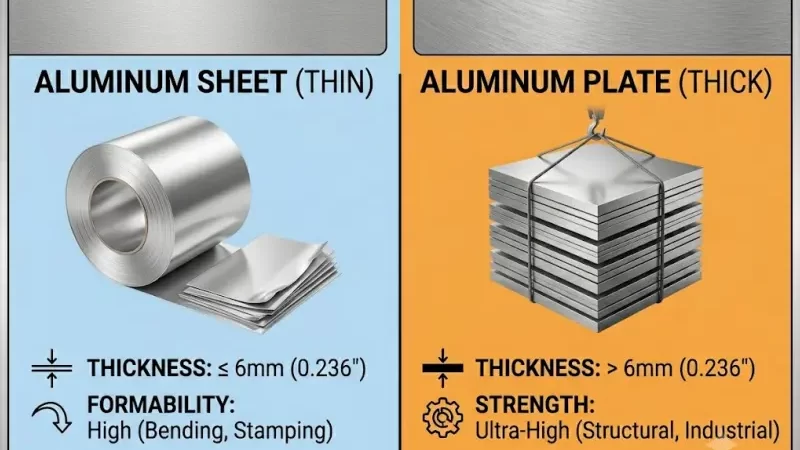
Many buyers use the words “sheet” and “plate” as if they mean the same thing. They do not. The main difference is thickness. In the aluminum world, the line sits at 6 mm or 0.25 inches. Anything thinner is a sheet. Anything thicker is a plate. This single factor changes how you cut, bend, weld, and use the metal.
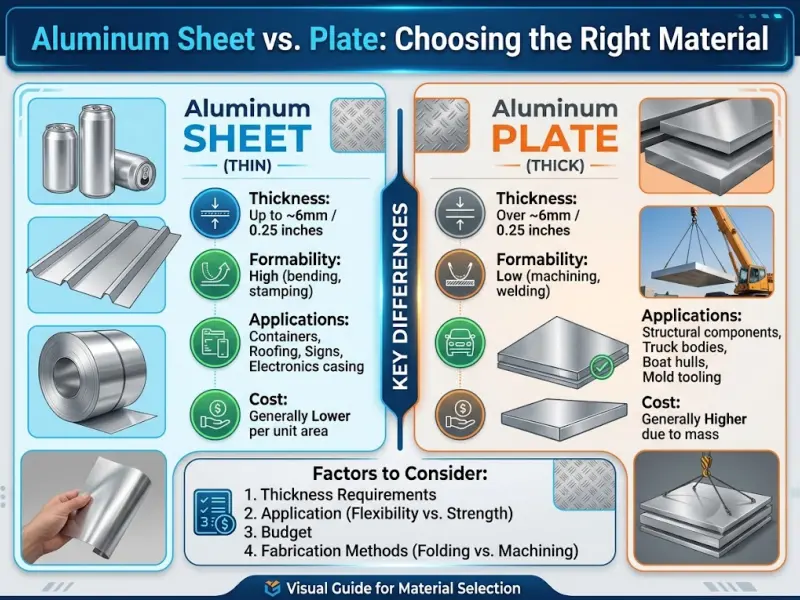
The aluminum sheet vs plate debate matters because picking the wrong form wastes money and time. A sheet that is too thin will sag under load. A plate that is too thick adds weight you do not need. This guide breaks down every factor so you can choose with confidence.
Thickness Breakdown: Where the Line Draws
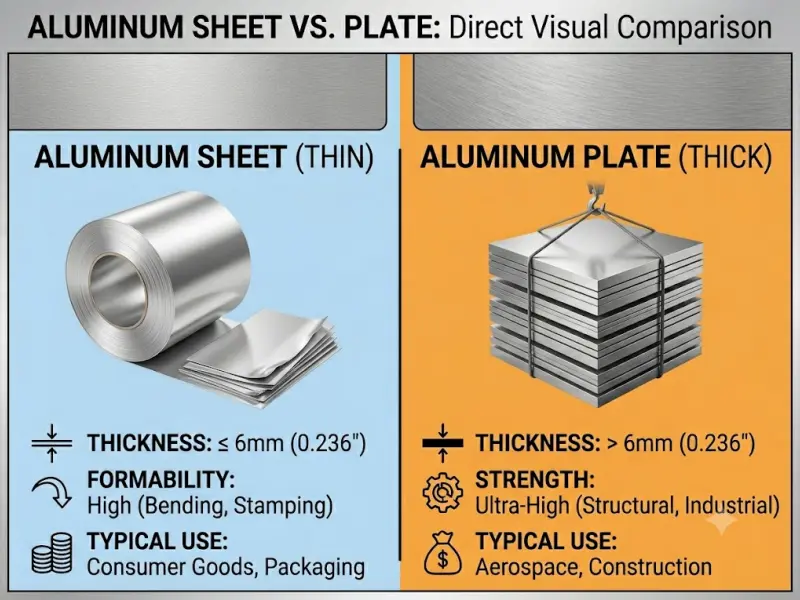
The thickness rule is not just industry slang. It affects price, handling, and performance. Here is a clear aluminum sheet vs plate thickness chart.
| Category | Thickness Range | Typical Forms | Weight per sq ft (1/8″ / 3mm) |
|---|---|---|---|
| Foil | 0.2 mm and under | Packaging, insulation | 0.11 lbs |
| Thin sheet | 0.5 mm to 1.5 mm | Cans, trim, signs | 0.22 to 0.66 lbs |
| Standard sheet | 1.5 mm to 6 mm | Panels, cladding, roofing | 0.66 to 2.64 lbs |
| Plate | 6 mm to 25 mm | Structural parts, tooling | 2.64 to 11.0 lbs |
| Heavy plate | 25 mm to 150 mm | Molds, armor, machine bases | 11.0 to 66.0 lbs |
The aluminum sheet vs plate thickness boundary is flexible. Some suppliers call 5 mm a plate. Others call 8 mm a thick sheet. Always check the actual measurement on the mill certificate. Do not trust the label alone.
Weight Comparison: Every Pound Counts
Weight drives shipping cost, fuel use, and handling effort. Aluminum saves weight over steel, but sheet and plate still differ.
| Thickness | Sheet or Plate | Weight per sq ft | Weight per 4×8 sheet |
|---|---|---|---|
| 1 mm | Sheet | 0.22 lbs | 7.0 lbs |
| 2 mm | Sheet | 0.44 lbs | 14.1 lbs |
| 3 mm | Sheet | 0.66 lbs | 21.1 lbs |
| 4 mm | Sheet | 0.88 lbs | 28.2 lbs |
| 5 mm | Sheet / Plate border | 1.10 lbs | 35.2 lbs |
| 6 mm | Plate | 1.32 lbs | 42.3 lbs |
| 10 mm | Plate | 2.20 lbs | 70.4 lbs |
| 12 mm | Plate | 2.64 lbs | 84.5 lbs |
| 20 mm | Plate | 4.40 lbs | 140.8 lbs |
| 25 mm | Plate | 5.50 lbs | 176.0 lbs |
A 3 mm aluminum sheet weighs half as much as a 6 mm aluminum plate of the same size. For a truck body, that difference could mean 50 kg saved per side panel. For a building facade, it means less load on the frame.
Alloy Choices for Sheets and Plates
Alloy selection does not change just because the form changes. But some alloys are more common in sheet. Others dominate the plate market.
Alloys Common in Sheet Form
1100 Alloy Aluminum Sheet
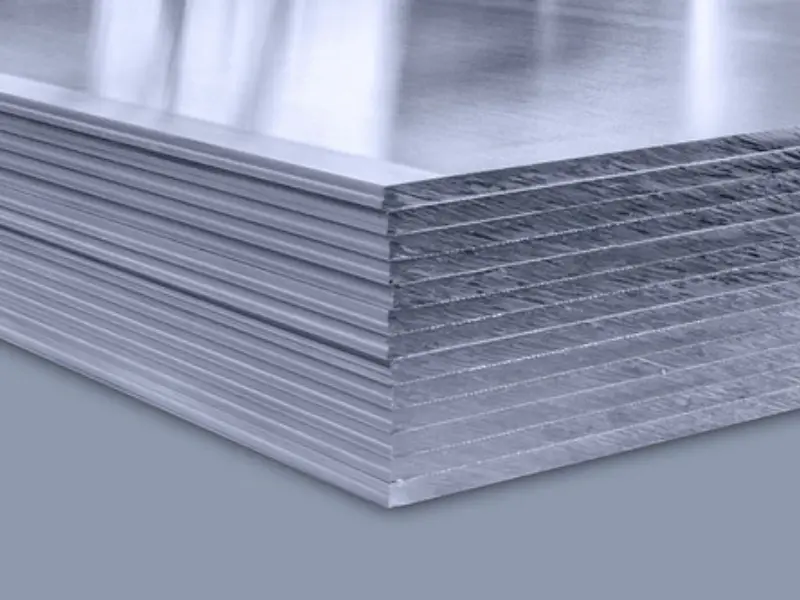
1100 is nearly pure aluminum at 99% minimum. It is soft, ductile, and highly corrosion resistant. You find it in chemical equipment, food handling, and decorative trim. It lacks strength for structural work.
| Property | Value |
|---|---|
| Purity | 99% Al minimum |
| Tensile strength (O) | 75 to 105 MPa |
| Common tempers | O, H14, H16 |
| Best use | Cooking utensils, reflectors, signage |
3003 Alloy Aluminum Sheet
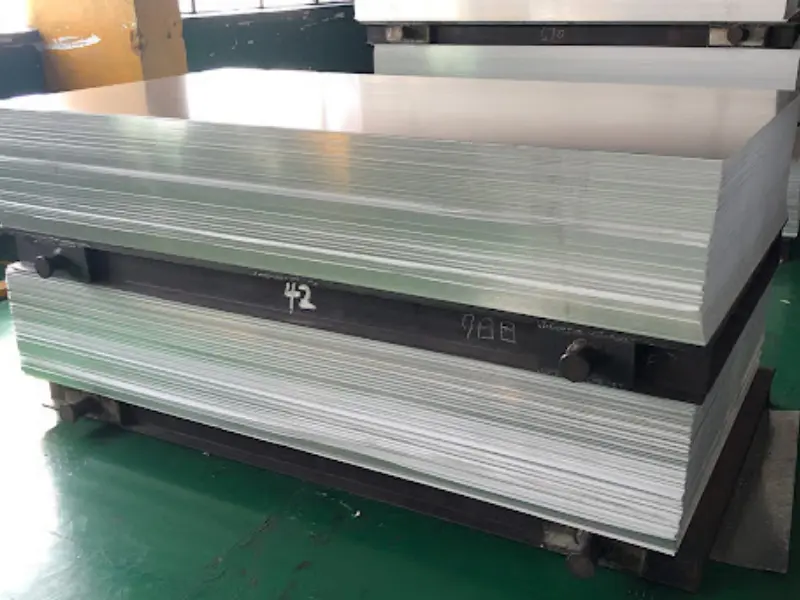
3003 adds manganese for extra strength. It is the workhorse of the sheet world. Roofing, siding, and fuel tanks use this alloy. It welds well and resists corrosion in most environments.
| Property | Value |
|---|---|
| Main element | 1.2% Mn |
| Tensile strength (H14) | 140 to 180 MPa |
| Common tempers | O, H14, H16, H18 |
| Best use | Roofing, cooking pans, chemical equipment |
5052 Alloy Aluminum Sheet
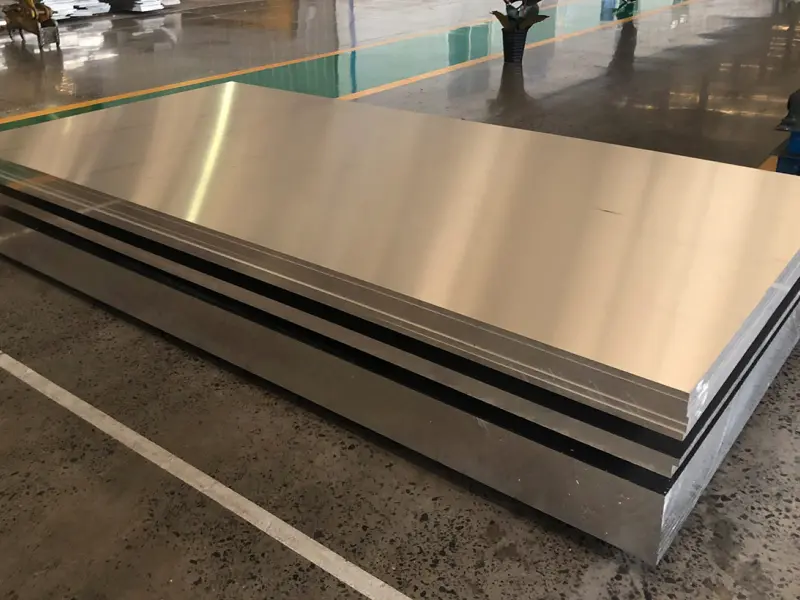
5052 contains magnesium. It is stronger than 3003 and resists saltwater. Marine and automotive applications favor this alloy. It forms easily and takes a good finish.
| Property | Value |
|---|---|
| Main element | 2.5% Mg |
| Tensile strength (H32) | 230 MPa |
| Common tempers | O, H32, H34 |
| Best use | Boat hulls, fuel tanks, pressure vessels |
Alloys Common in Plate Form
5083 Alloy Aluminum Plate
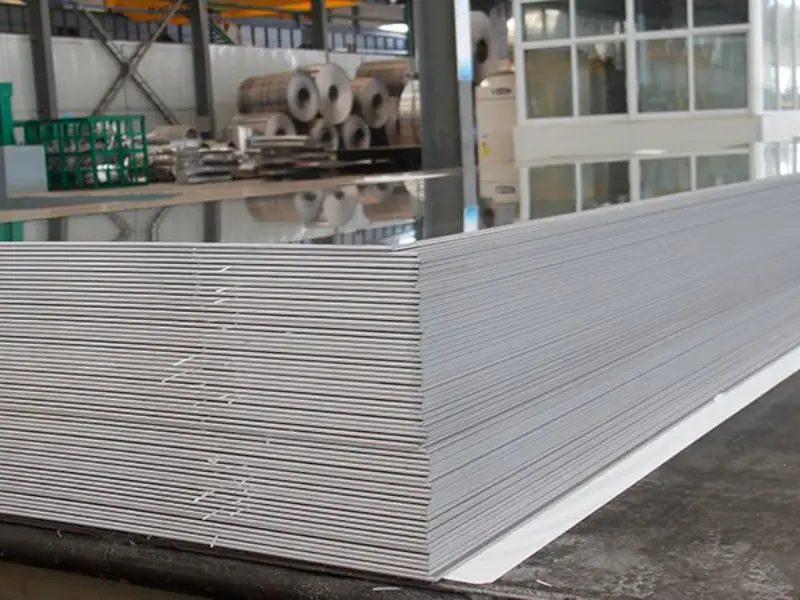
5083 is the marine grade standard. It keeps strength after welding. Shipbuilders use it for hulls, decks, and superstructures. It resists seawater corrosion for decades.
| Property | Value |
|---|---|
| Main elements | 4.5% Mg, 0.7% Mn |
| Tensile strength (H321) | 305 to 380 MPa |
| Common tempers | O, H111, H321 |
| Best use | Ship hulls, offshore platforms, rail cars |
6061 Alloy Aluminum Plate
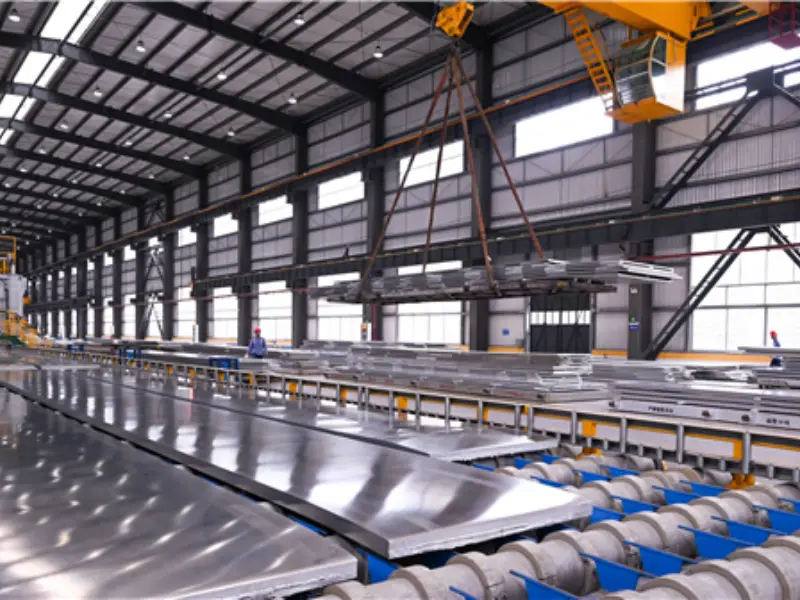
6061 is the most versatile structural alloy. Heat treatment pushes its strength high. It machines cleanly and accepts anodizing. Bridges, towers, and machine parts use this alloy.
| Property | Value |
|---|---|
| Main elements | 1.0% Mg, 0.6% Si |
| Tensile strength (T6) | 290 MPa |
| Common tempers | T6, T651 |
| Best use | Structural frames, tooling, automotive parts |
7075 Alloy Aluminum Plate
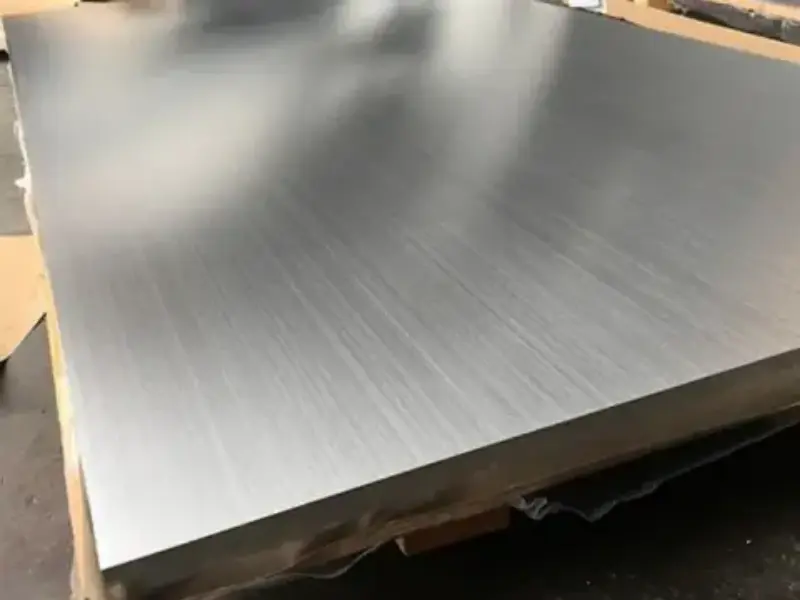
7075 is one of the strongest aluminum alloys. Aircraft and defense industries rely on it. The trade-off is poor weldability and lower corrosion resistance than 5083 or 6061.
| Property | Value |
|---|---|
| Main element | 5.6% Zn |
| Tensile strength (T6) | 540 MPa |
| Common tempers | T6, T651, T7351 |
| Best use | Aircraft structures, high-stress parts |
Temper Codes: What They Mean for Sheet and Plate
Temper tells you how the metal was treated after rolling. Sheet and plate share the same temper system, but some tempers are more common in one form.
| Temper | Name | Typical Use in Sheet | Typical Use in Plate |
|---|---|---|---|
| O | Annealed | Deep drawing, complex forming | Stress relief after welding |
| H12 | Quarter hard | General forming | Rare in plate |
| H14 | Half hard | Panels, brackets | Rare in plate |
| H16 | Three-quarter hard | Stiff panels | Rare in plate |
| H18 | Full hard | Rigid trim, springs | Rare in plate |
| H22 | Quarter hard, annealed | Better formability | Rare in plate |
| H32 | Quarter hard, stabilized | Marine sheet | Some plate uses |
| T4 | Solution treated, naturally aged | Forming before aging | Pre-forming stage |
| T6 | Solution treated, artificially aged | Structural sheet | Most common plate temper |
| T651 | T6 plus stress relieved | Precision sheet | Machine-ready plate |
| T7351 | Overaged for stress corrosion | Aircraft sheet | Aircraft plate |
The aluminum sheet vs plate temper choice affects your fabrication plan. A T6 plate is hard and strong. It machines well but resists bending. An O-temper sheet bends easily but will not hold tight tolerances.

Surface Finishes: Sheet vs Plate Options
Both sheet and plate come in various finishes. But some finishes are easier to apply to thin sheet. Others suit thick plate better.
Mill Finish Aluminum Sheet vs Plate
Mill finish is the raw surface from the rolling mill. It is dull and slightly textured. Both sheet and plate come in this finish. It is the cheapest option and works when the surface will be hidden or painted.
Bright Finish Aluminum Sheet vs Plate
Bright finish is only common on thin sheet. The rolling process polishes the surface. Reflectors, decorative trim, and lighting fixtures use bright finished sheet. Thick plate cannot achieve this shine through rolling alone.
Anodized Finish Aluminum Sheet vs Plate
Anodizing builds a hard oxide layer. It works on both sheet and plate. But thin sheet anodizes more evenly. Thick plate may show color variation between the surface and edges. Architectural panels and electronic housings use anodized sheet. Machine bases and tooling plates use anodized plate for wear resistance.
Painted and Coated Finishes Aluminum Sheet vs Plate
Pre-painted sheet is common in roofing and siding. The coil coating process applies paint before the sheet is cut. Plate is rarely pre-painted. It is usually painted after fabrication. Powder coating works on both forms but requires oven size limits for large plate.
| Finish | Common in Sheet | Common in Plate | Notes |
|---|---|---|---|
| Mill finish | Yes | Yes | Standard, cheapest |
| Bright finish | Yes | No | Rolling process only |
| Anodized | Yes | Yes | Better on thin material |
| Pre-painted | Yes | Rare | Coil coating for sheet |
| Powder coated | After fabrication | After fabrication | Oven size limits plate |
| Polished | After fabrication | After fabrication | Labor intensive on plate |
Fabrication Differences: What Changes with Thickness
Cutting, bending, and welding behave differently as thickness grows. The aluminum sheet vs plate fabrication gap is real.
Cutting Methods
Thin sheet cuts with hand tools. Tin snips handle 1 mm and 2 mm sheet. A jigsaw with a metal blade cuts up to 3 mm. Thicker sheet and all plate need power tools.
| Thickness | Tool | Speed | Edge Quality |
|---|---|---|---|
| 0.5 to 2 mm | Tin snips | Slow | Moderate |
| 1 to 4 mm | Jigsaw | Medium | Moderate |
| 2 to 6 mm | Circular saw | Fast | Good |
| 3 to 12 mm | Shear | Fast | Good |
| 6 to 50 mm | Bandsaw | Medium | Good |
| 6 to 150 mm | Plasma / laser | Fast | Excellent |
| All thicknesses | Waterjet | Slow | Excellent |
Plate cutting costs more than sheet cutting. A waterjet cut on 25 mm plate takes longer and uses more abrasive than on 3 mm sheet. Plasma cuts plate fast but leaves a heat-affected zone that may need grinding.
Bending and Forming
Sheet bends easily. A brake press handles 1 mm to 6 mm with standard tooling. Hand bending works for thin gauges with a simple bench brake. Plate bending needs serious force.
| Thickness | Bending Method | Minimum Radius | Springback |
|---|---|---|---|
| 1 mm | Hand brake | 1x thickness | Low |
| 2 mm | Bench brake | 1.5x thickness | Low |
| 3 mm | Press brake | 2x thickness | Moderate |
| 4 mm | Press brake | 2.5x thickness | Moderate |
| 5 mm | Press brake | 3x thickness | High |
| 6 mm | Heavy press brake | 3.5x thickness | High |
| 10 mm | Roll forming | 4x thickness | Very high |
| 12 mm | Roll forming or hot forming | 5x thickness | Very high |
The aluminum sheet vs plate bending difference means you need different equipment. A small shop can form sheet. Plate forming needs industrial machinery.
Welding Considerations
Both sheet and plate weld with MIG or TIG. But heat control changes. Thin sheet warps easily. You need lower amperage and faster travel speed. Thick plate needs preheat and multi-pass welding.
| Thickness | Process | Amperage | Passes | Preheat |
|---|---|---|---|---|
| 1 to 2 mm | TIG | 60 to 100 A | Single | None |
| 2 to 4 mm | TIG or MIG | 100 to 150 A | Single | None |
| 4 to 6 mm | MIG | 150 to 200 A | Single or double | None |
| 6 to 12 mm | MIG | 200 to 280 A | Double or triple | Optional |
| 12 to 25 mm | MIG | 280 to 350 A | Multiple | Recommended |
| 25 to 50 mm | MIG | 350 to 450 A | Many | Required |
Sheet welding is forgiving. Plate welding demands skill. A 25 mm plate joint needs proper groove preparation, preheat, and interpass temperature control.
Cost Factors: Sheet vs Plate Pricing
Price depends on alloy, temper, finish, and thickness. But the sheet to plate jump adds a premium beyond just material weight.
| Factor | Sheet Impact | Plate Impact |
|---|---|---|
| Raw material | Lower per sq ft | Higher per sq ft |
| Rolling cost | Lower | Higher (more passes) |
| Heat treatment | Rare | Common (adds cost) |
| Cutting cost | Lower | Higher (slower, more power) |
| Shipping cost | Lower (lighter) | Higher (heavier) |
| Handling cost | Manual possible | Crane or forklift needed |
| Scrap rate | Lower | Higher (harder to form) |
A 3 mm 5052-H32 sheet costs less per square foot than a 6 mm 5083-H321 plate. But the plate may last longer in a marine environment. The aluminum sheet vs plate cost decision must include service life, not just purchase price.
Applications: Where Sheet Wins
Sheet dominates applications that need light weight, easy forming, and large surface coverage.
Building and Construction
- Roofing panels and standing seam systems
- Wall cladding and curtain walls
- Ceiling tiles and suspended systems
- Flashing and trim pieces
- Gutter and downspout systems
- Insulation facing and vapor barriers
Transportation
- Trailer siding and roofing
- Bus and train interior panels
- Aircraft fuselage skin (thin sheet)
- Automotive body panels
- Shipping container walls
Packaging and Consumer Goods
- Beverage cans and food containers
- Cookware and kitchen utensils
- Laptop and phone housings
- Lighting reflectors and fixtures
- Signage and display boards
Electrical and Electronics
- Bus bars and heat sinks (thick sheet)
- Circuit board substrates
- LED panel backplates
- Transformer windings (foil)
- Shielding enclosures
Applications: Where Plate Wins
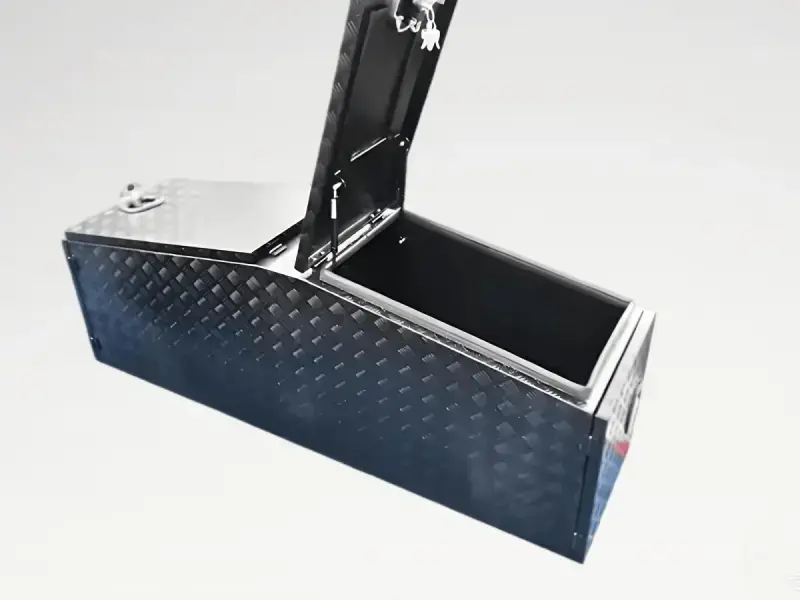
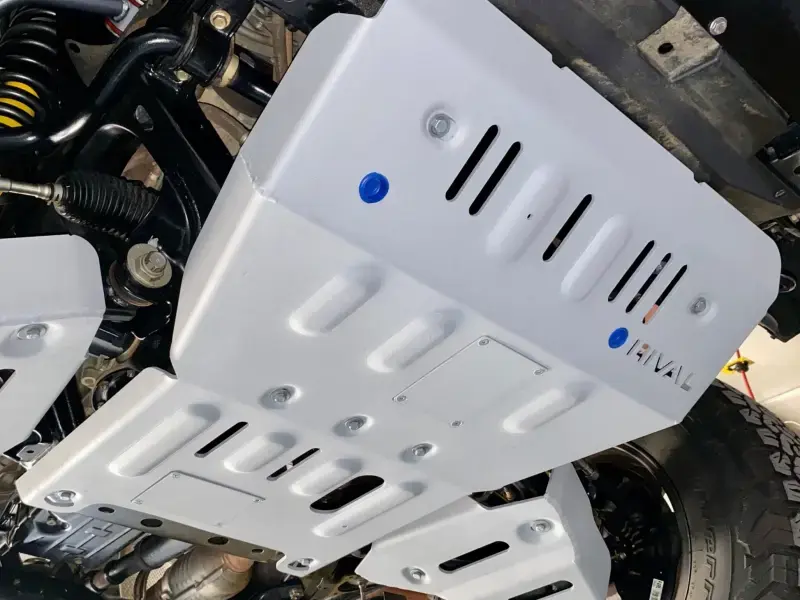
Plate serves when strength, rigidity, and wear resistance matter more than weight savings.
Marine and Offshore
- Ship hulls and deck structures
- Offshore platform modules
- Submarine pressure hulls
- Propeller hubs and rudders
- Anchor and mooring fittings
Aerospace and Defense
- Wing spars and bulkheads
- Landing gear components
- Armor plate for vehicles
- Missile and rocket structures
- Satellite mounting platforms
Industrial Machinery
- Machine tool beds and bases
- Injection mold bases
- Press brake dies and punches
- Robot arm structures
- Conveyor frame sections
Structural Engineering
- Bridge deck components
- Tower and mast sections
- Crane boom segments
- Building frame nodes
- Stadium roof supports
Applications: The Overlap Zone
Some jobs sit in the middle. Both sheet and plate can work. The choice depends on load, budget, and fabrication capacity.
Truck and Trailer Bodies
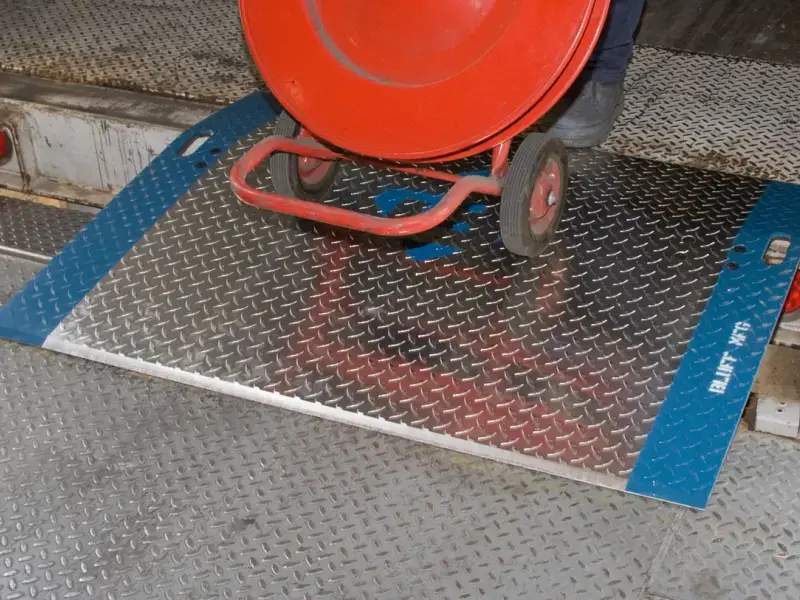
Side walls often use 2 mm to 4 mm sheet. Floors may use 4 mm sheet or 6 mm plate depending on cargo weight. Ramps and loading gates favor 6 mm to 10 mm plate.
Storage Tanks
Small tanks use 3 mm to 5 mm sheet. Large industrial tanks need 6 mm to 12 mm plate for structural integrity. Pressure vessels always use plate.
Architectural Panels
Decorative panels use 2 mm to 3 mm sheet. Blast-resistant panels need 10 mm to 25 mm plate. Sun shades and louvers use thin sheet. Canopy supports may use plate.
How to Choose: A Decision Framework
Follow these steps to pick the right form for your project.
Step One: Define the Load
Will the material carry weight? If yes, calculate the stress. Use engineering tables or finite element analysis. If stress exceeds sheet capacity, move to plate.
Step Two: Check the Span
Long spans need thicker material. A 2 mm sheet may span 600 mm between supports. A 1 meter span needs 3 mm or 4 mm. Spans over 2 meters usually need plate or added framing.
Step Three: Consider Fabrication
Do you have plate-cutting equipment? Can your brake press handle 6 mm? If your shop is set up for sheet, moving to plate means new tools or outsourcing.
Step Four: Factor Weight
Every kilogram matters in transport and aerospace. Sheet saves weight. Plate adds strength. Find the balance for your application.
Step Five: Set the Budget
Plate costs more to buy, cut, ship, and handle. But it may last longer. Calculate total cost of ownership, not just purchase price.
Common Mistakes Buyers Make
Mistake One: Assuming Sheet and Plate Are Interchangeable
A 4 mm sheet and a 6 mm plate are close in thickness. But the plate may be a different alloy in a different temper. Never substitute without checking specs.
Mistake Two: Ignoring Temper
A 6061-O sheet is soft and formable. A 6061-T6 plate is hard and strong. The same alloy behaves very differently. Match temper to your fabrication plan.
Mistake Three: Forgetting Tolerances
Sheet tolerances are tighter than plate tolerances. A 3 mm sheet may vary plus or minus 0.1 mm. A 25 mm plate may vary plus or minus 0.5 mm. Precision parts need sheet or precision plate.
Mistake Four: Wrong Finish Choice
Pre-painted sheet cannot be welded without burning the paint. Anodized plate may need masking before machining. Plan your finish after you know your fabrication steps.
Mistake Five: Poor Storage
Sheet stacks flat easily. Plate needs stronger racks. Wet storage stains both forms. Separate different alloys to prevent galvanic corrosion.
Quality Standards for Sheet and Plate
Both forms must meet standards. But the tests differ.
| Standard | Applies To | Covers |
|---|---|---|
| ASTM B209 | Sheet and plate | Alloy, temper, dimensions |
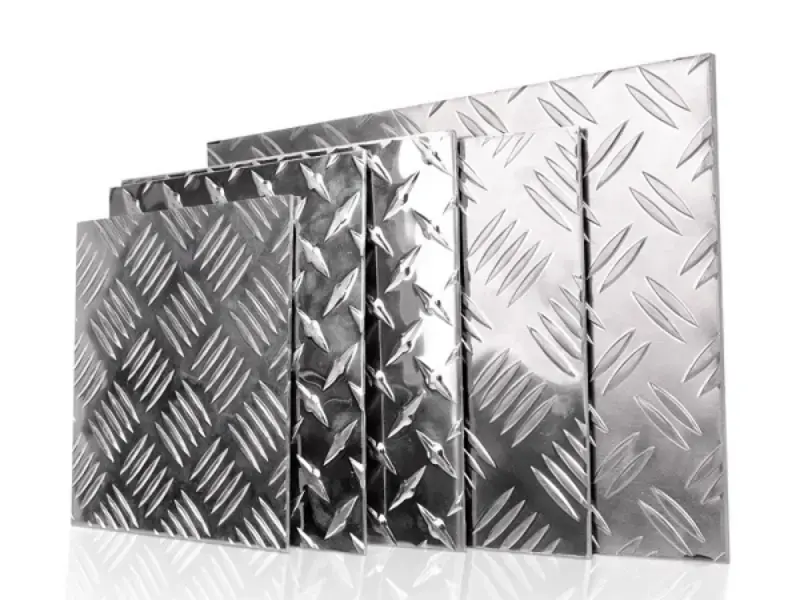
| ASTM B632 | Sheet and plate | Tread plate (diamond pattern) |
| EN 485-1 | Sheet and plate | Dimensions and tolerances |
| EN 573-3 | Sheet and plate | Chemical composition |
| EN 755-2 | Plate and extrusions | Mechanical properties |
| AMS 4025 | Sheet | 6061-T6 aerospace sheet |
| AMS 4045 | Sheet | 7075-T6 aerospace sheet |
| AMS 4078 | Plate | 7075-T651 aerospace plate |
| DNV GL-RU-C2 | Plate | Marine grade approval |
Always request a mill test certificate. It proves the material meets the standard you paid for.
Frequently Asked Questions
What is the main difference between aluminum sheet and plate?
Thickness. Sheet is 6 mm or thinner. Plate is 6 mm or thicker. The alloy and temper may also differ. Sheet is usually softer and more formable. Plate is usually stronger and more rigid.
Can I use sheet instead of plate to save money?
Only if the load allows. A sheet that is too thin will bend, sag, or fail. The cost of failure exceeds the savings. Always check structural requirements before downsizing thickness.
Is 6 mm a sheet or a plate?
It depends on the supplier. Some call 6 mm a thick sheet. Others call it a thin plate. The ASTM B209 standard does not draw a hard line. Always check the actual thickness on the certificate.
Which is easier to weld, sheet or plate?
Sheet is more forgiving. It heats faster and cools faster. Warping is the main risk. Plate needs more skill. Preheat and multi-pass welding are often required. But plate joints are stronger due to thicker material.
Can plate be bent like sheet?
Not easily. Plate needs heavy equipment. A 12 mm plate may need a 200-ton press brake or roll forming machine. The minimum bend radius is also larger. Some alloys in plate form crack if bent too tightly.
Does plate cost more per pound than sheet?
Usually yes. Plate requires more rolling passes. Heat treatment adds cost. Cutting and handling cost more. But plate delivers more strength per pound when you need it.
What alloy should I choose for outdoor use?
5052-H32 sheet or 5083-H321 plate resist weather well. 6061-T6 also works if anodized or painted. Avoid 1100 and 3003 in harsh coastal or industrial environments. They corrode faster.
How do I prevent galvanic corrosion between sheet and plate?
Use the same alloy when possible. If you must mix alloys, add an insulating barrier. Paint or tape between the surfaces works. Use compatible fasteners. Stainless steel bolts with aluminum washers create less galvanic risk than plain steel.
Can I polish sheet to look like plate?
Sheet polishes easier than plate. The rolling process already creates a smoother surface. Plate needs more grinding and buffing to achieve the same shine. Both can reach a mirror finish with enough effort.
What is the thickest aluminum sheet available?
Most suppliers stock sheet up to 6 mm. Some offer 8 mm as sheet. Beyond that, you are in plate territory. Custom orders can blur the line, but 6 mm is the industry norm.
How do I ship plate safely?
Plate ships on flatbed trucks or in containers. It must be secured to prevent shifting. Use edge protectors to prevent strap damage. Separate sheets with paper or plastic to prevent scratching. A 25 mm plate can weigh hundreds of kilograms per sheet. Forklifts or cranes handle loading.
Can I anodize both sheet and plate?
Yes. But thin sheet anodizes more evenly. Thick plate may show color variation. The oxide layer depth is limited by the alloy, not the thickness. 6061 anodizes better than 5052 or 5083.
Quick Reference: Sheet vs Plate at a Glance
| Factor | Aluminum Sheet | Aluminum Plate |
|---|---|---|
| Thickness | 0.2 mm to 6 mm | 6 mm to 150 mm+ |
| Weight | Light | Heavy |
| Formability | Excellent | Moderate to poor |
| Strength | Low to moderate | Moderate to very high |
| Cutting ease | Easy | Harder, needs power tools |
| Welding ease | Easy | Needs skill, may need preheat |
| Typical alloys | 1100, 3003, 5052 | 5083, 6061, 7075 |
| Typical tempers | O, H14, H32 | T6, T651, H321 |
| Surface finishes | Mill, bright, painted, anodized | Mill, anodized, machined |
| Cost per sq ft | Lower | Higher |
| Handling | Manual possible | Crane or forklift needed |
| Best for | Panels, cladding, light structures | Structural parts, heavy loads |
Aluminum Sheet vs. Plate: Choosing the Right Material
The aluminum sheet vs plate choice is not about which is better. It is about which fits your job. Sheet offers light weight, easy forming, and low cost. Plate delivers strength, rigidity, and durability under load. Match the thickness, alloy, temper, and finish to your application. Check standards. Request mill certificates. Plan your fabrication before you order. With the right material, your project will perform well and last long.