Difference Between Hot and Cold Rolling
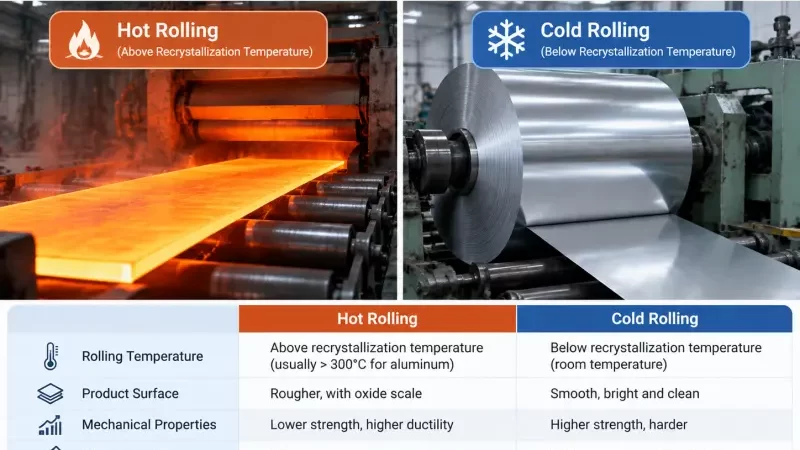
Hot rolling and cold rolling are the main production techniques of aluminum products.
Both of them belong to metal process technique. Taking aluminum circle as an example.
Due to the different production processes, there are hot rolling aluminum circle and cold rolling aluminum circle in the market.
What is Hold Rolling?
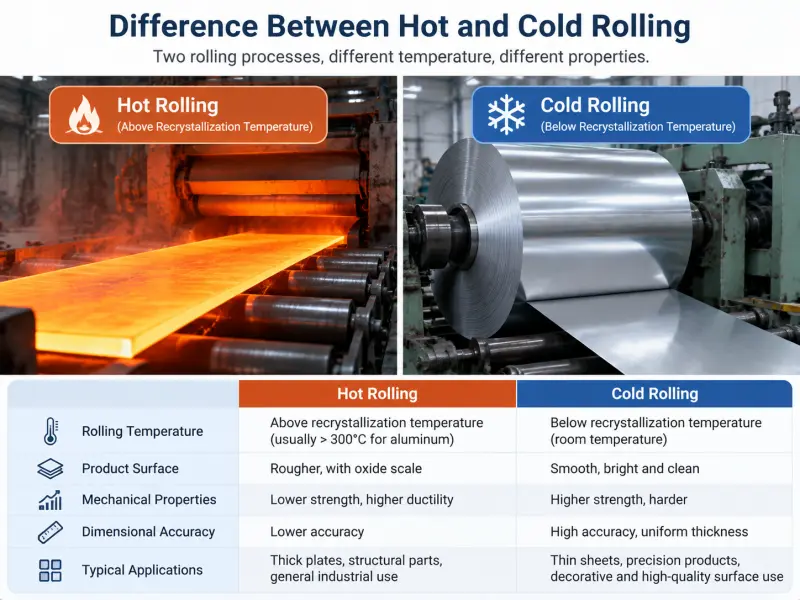
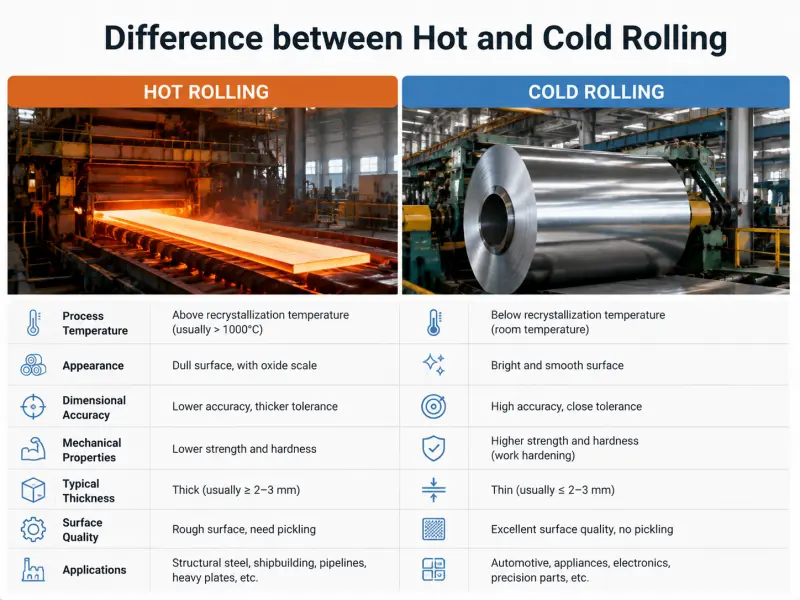
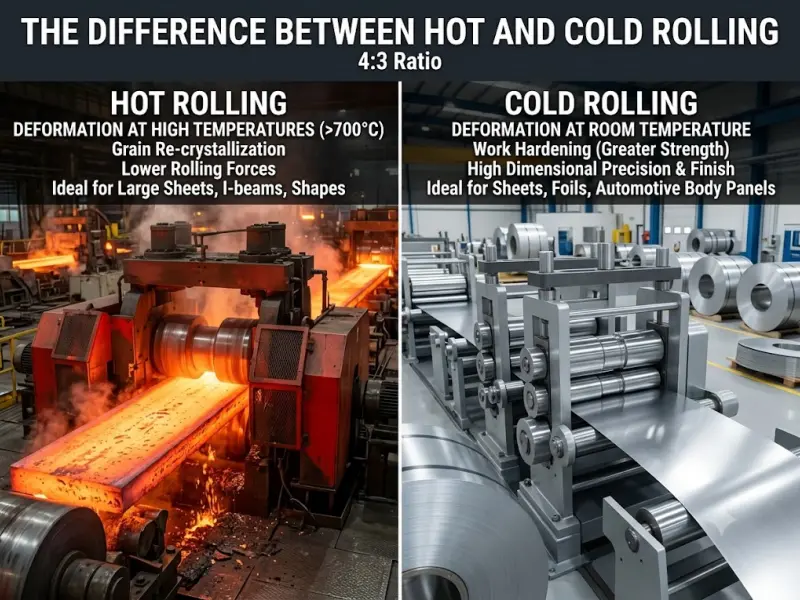
In terms of processing technology, hot rolling is hot working. Hot rolling refers to rolling above the crystallization temperature.
The technique has unique features include low energy consumption, good plastic processing, low deformation resistance, insignificant work hardening, easy rolling, and reduced energy consumption required for metal deformation.
Hot rolling is mainly used to produce steel structures, bridges, ships, vehicles and various mechanical parts.
What is Cold Rolling?
Cold rolling is relative to hot rolling. It’s cold working. And it refers to rolling below the crystallization temperature.
Compared with hot rolling, cold rolling aluminum products have high strength.
Therefore, cold rolling is very suitable for household appliances such as automobiles, refrigerators, washing machines, as well as industrial equipment and various building materials.
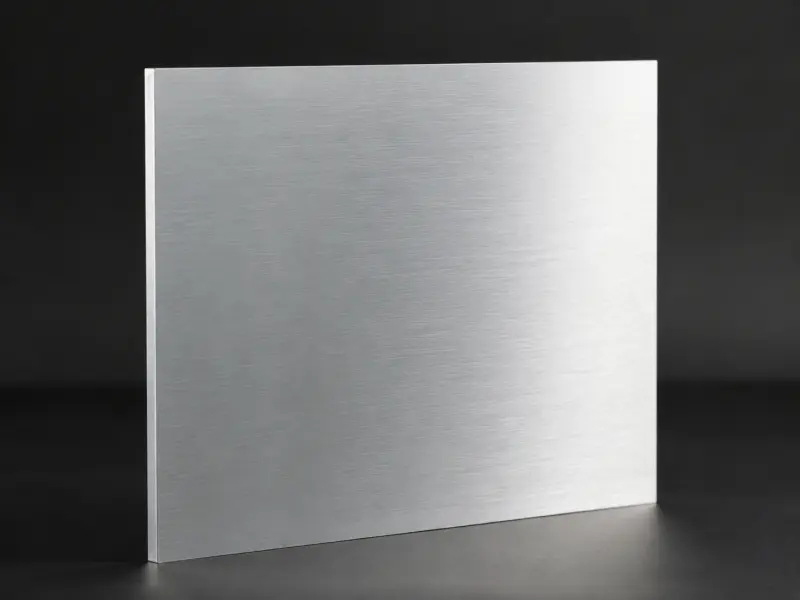
Hot Rolling vs Cold Rolling
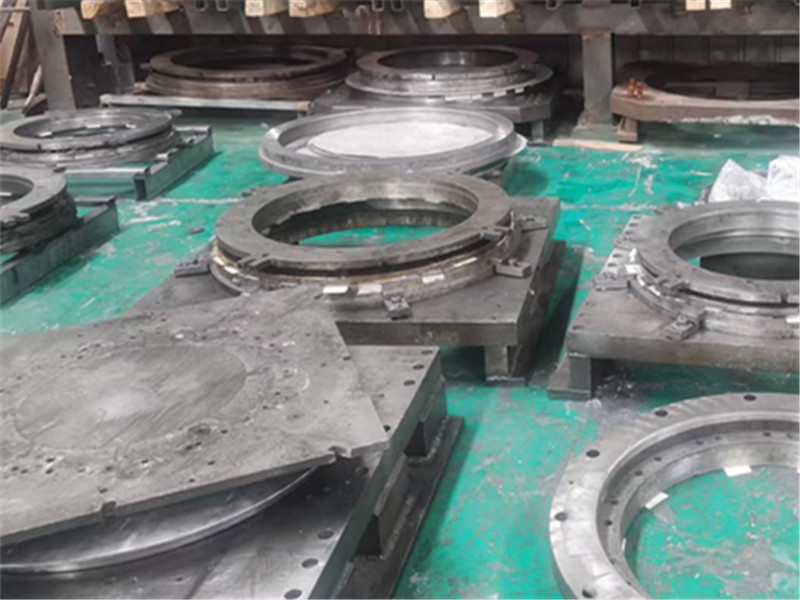
- Price:The process of cold rolling aluminum circle is simple, and the price is cheaper than that of hot rolling aluminum circle.
- Different Properties:Hot rolling aluminum circle has good surface quality, strong mechanical properties and ductility, and good oxidation effect. Cold rolling aluminum circle has high strength.
- Different Uses:Cold rolling aluminum circles are mostly used in molds, and hot rolling aluminum sheets are suitable for stamping and stretching.
- Finished Product Difference:Usually the elongation of the cold rolled end product is lower than that of the hot rolled end product.
Our company produce hot rolling and cold rolling aluminum products. According to the needs of customers, our company provides aluminum products in various widths and thicknesses. More information, welcome to contact us.
Difference between Hot and Cold Rolling
Hot Rolling: The Basics for Heavy-Duty Builds
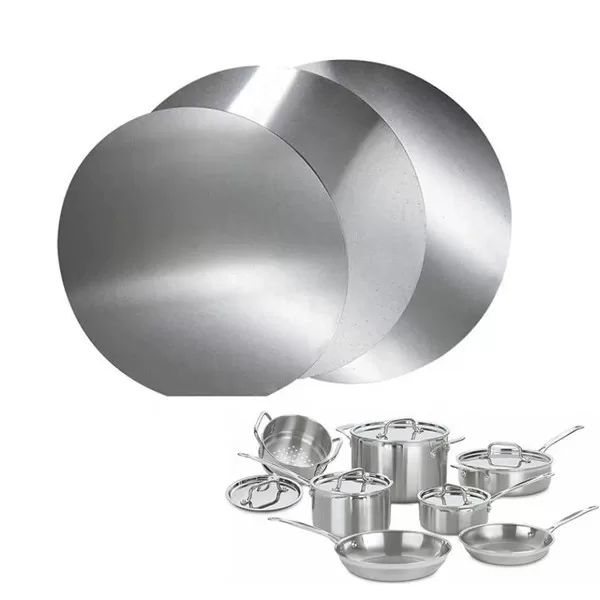
Hot rolling shapes metal at temperatures above 1,700°F.
At this heat, steel and aluminum become soft and easy to form. The material passes through large rollers that squeeze it into sheets, bars, or structural shapes. The process is fast and handles thick sections without trouble.
The surface of hot rolled metal carries mill scale. This is a dark oxide layer that forms during heating.
The scale protects the metal from rust for a short time, but it must be removed before painting or welding. Hot rolled products have slightly rounded edges and looser tolerances.
The thickness can vary by a few tenths of a millimeter from one edge to another.
Hot rolling does not strain-harden the metal. The grains recrystallize during rolling, so the material stays ductile. This makes hot rolled metal easy to bend, weld, and cut into large structures. The cost is lower because the process skips extra finishing steps.
| Feature | Hot Rolled Value |
|---|---|
| Temperature | Above 1,700°F (925°C) |
| Surface | Rough, with mill scale |
| Tolerance | ±0.5 mm to ±2.0 mm |
| Strength | Lower yield, high ductility |
| Cost | Lower per ton |
| Max thickness | No real upper limit |
Cold Rolling: Precision from Room Temperature
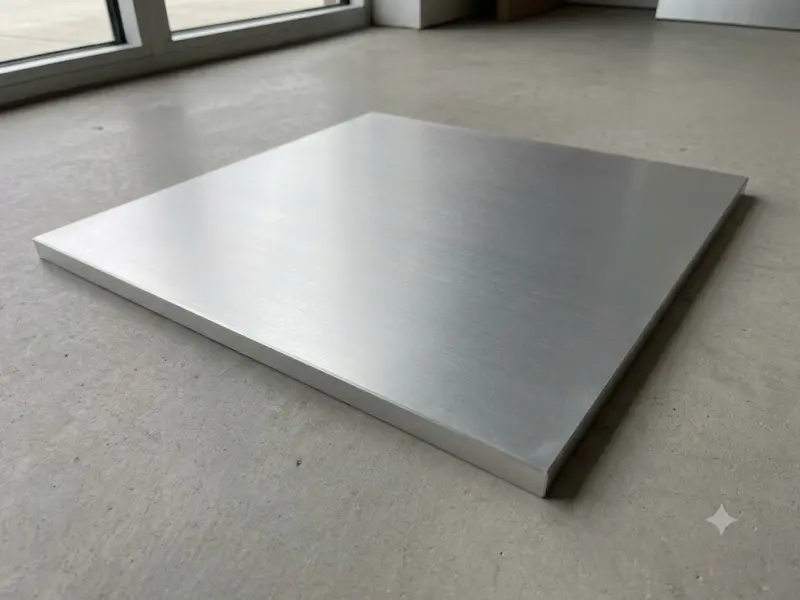
Cold rolling takes hot rolled metal and passes it through rollers at room temperature.
The metal is already cooled and cleaned, usually by pickling to remove scale. The cold rollers squeeze the metal thinner and smoother.
Because the metal is cold, it work-hardens. This means the grains deform and lock into each other. The result is higher strength, harder surface, and tighter tolerances.
A cold rolled sheet can hold thickness within ±0.01 mm. The surface is smooth, shiny, and ready for paint or plating without extra prep.
Cold rolling cannot handle very thick sections. The pressure needed to squeeze thick metal at room temperature is enormous. Most cold rolled sheet stays below 6 mm. Thin foil and precision strip are almost always cold rolled.
| Feature | Cold Rolled Value |
|---|---|
| Temperature | Room temperature |
| Surface | Smooth, bright, no scale |
| Tolerance | ±0.01 mm to ±0.05 mm |
| Strength | Higher yield, harder |
| Cost | Higher per ton |
| Typical thickness | 0.3 mm to 6 mm |
Alloy Breakdown: How Different Metals React
Not every alloy behaves the same under hot or cold rollers. The composition changes how the metal flows, hardens, and finishes.
Carbon Steel Grades
Carbon steel is the most common material for both processes. Hot rolled carbon steel is used for beams, plates, and general fabrication. Cold rolled carbon steel becomes sheet for cars, appliances, and furniture.
| Grade | Hot Rolled Use | Cold Rolled Use |
|---|---|---|
| A36 / S235 | Structural beams, columns | Not common |
| A1011 | General plate, tubing | Base for cold rolling |
| A1008 | Rare in hot form | Sheet, stampings, panels |
| C1018 | Bars, shafts | Precision shafts, pins |
Stainless Steel Grades
Stainless steel can be hot or cold rolled. The choice depends on the finish and tolerance needed.
| Grade | Hot Rolled Finish | Cold Rolled Finish |
|---|---|---|
| 304 | No. 1 (rough, annealed) | 2B (smooth), BA (bright) |
| 316 | No. 1 (industrial) | 2B (precision, marine) |
| 430 | Hot band for descaling | 2B (appliance trim) |
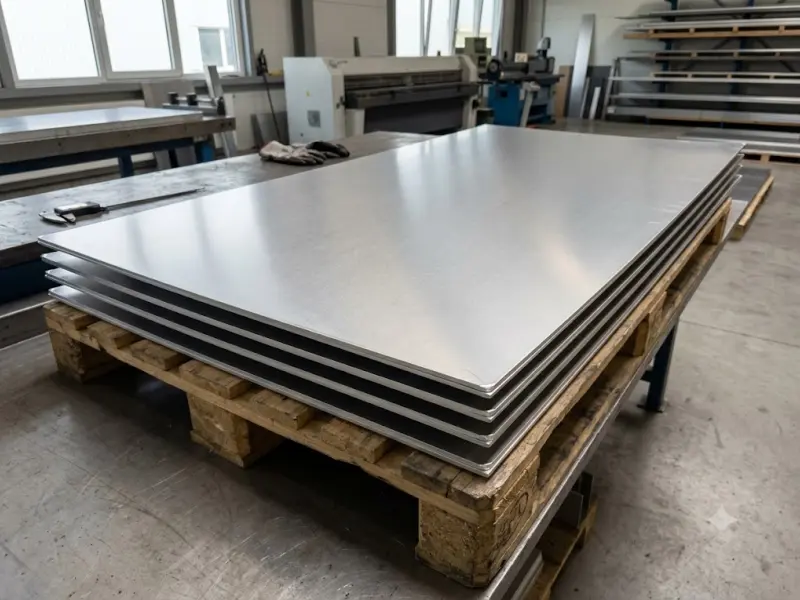
Hot rolled stainless usually ends up as thick plate or as feedstock for cold mills. Cold rolled stainless is what you see on kitchen equipment, elevator panels, and medical devices.
Aluminum Alloys
Aluminum is softer than steel, so both processes are common. Hot rolling breaks down thick cast slabs. Cold rolling finishes the sheet to exact thickness and surface.
| Alloy | Hot Rolled Role | Cold Rolled Role |
|---|---|---|
| 1050 | Slab breakdown, thick plate | Foil, thin strip, caps |
| 3003 | Circles for cookware, thick sheet | HVAC fins, license plates |
| 5052 | Marine plate, thick panels | Trailer siding, fuel tanks |
| 6061 | Structural plate, extrusion feed | Precision sheet, machined parts |
Temper States After Rolling
Rolling changes the temper of the metal. The temper tells you how hard or soft the material is when it reaches your shop.
Hot Rolled Tempers
Hot rolled metal is usually sold in annealed or as-rolled condition. The heat of rolling keeps the grains soft.
| Temper | Name | Condition |
|---|---|---|
| As-rolled | Hot band | Direct from mill, may have scale |
| Annealed | Solution treated | Softened for further forming |
| Normalized | Air cooled | Balanced strength and ductility |
Cold Rolled Tempers
Cold rolled metal gains hardness from the rolling itself. Annealing after rolling can soften it again if needed.
| Temper | Name | Condition |
|---|---|---|
| Quarter hard | 1/4 hard | Light cold work, some spring |
| Half hard | 1/2 hard | Moderate strength, good form |
| Full hard | Full hard | Maximum cold work, stiff |
| Annealed | Dead soft | Recrystallized, very ductile |
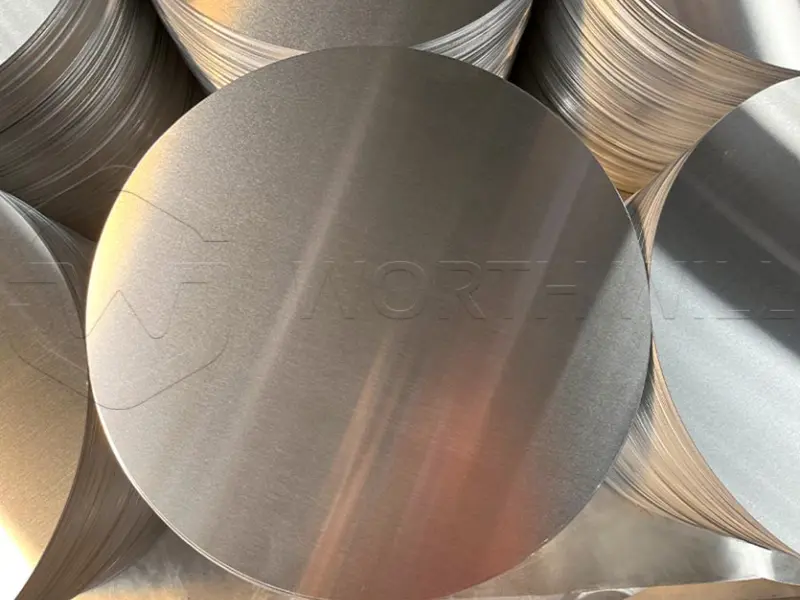
For example, cold rolled steel in full hard temper has yield strength roughly double that of hot rolled steel of the same grade. If you need to stamp complex shapes, you may order cold rolled annealed dead soft and let the stamping work-harden the part.
Thickness Limits: What Each Process Can Handle
Thickness is where hot and cold rolling split apart. Hot rolling owns the thick end of the spectrum. Cold rolling owns the thin and precise end.
Hot Rolled Thickness Range
| Product | Typical Thickness |
|---|---|
| Heavy plate | 6 mm to 150 mm |
| Structural sheet | 3 mm to 25 mm |
| Hot rolled coil | 1.2 mm to 12 mm |
| Railway rail | Up to 150 mm |
Hot rolling can go even thicker for specialized forgings or pressings. There is no hard ceiling.
Cold Rolled Thickness Range
| Product | Typical Thickness |
|---|---|
| Cold rolled sheet | 0.3 mm to 3.0 mm |
| Cold rolled strip | 0.1 mm to 2.0 mm |
| Foil stock | 0.05 mm to 0.2 mm |
| Precision shim | 0.01 mm to 0.1 mm |
Cold rolling below 0.3 mm requires special mills and very clean feedstock. Aluminum foil as thin as 0.006 mm is made by cold rolling with intermediate anneals.
Surface Talk: Scale vs. Smooth
The surface finish is the easiest way to tell hot and cold rolled metal apart at a glance.
| Property | Hot Rolled | Cold Rolled |
|---|---|---|
| Color | Blue-gray, dark | Silver-gray, bright |
| Texture | Rough, scaly | Smooth, even |
| Mill scale | Present | Removed by pickling |
| Oil coating | Rare | Common for rust prevention |
| Paint prep | Requires blasting or pickling | Often paint-ready |
Hot rolled sheet with mill scale can be painted if the scale is tight. However, scale flakes off over time, taking the paint with it. Cold rolled sheet needs only a degreasing wipe before primer.
Strength and Ductility: A Head-to-Head Comparison
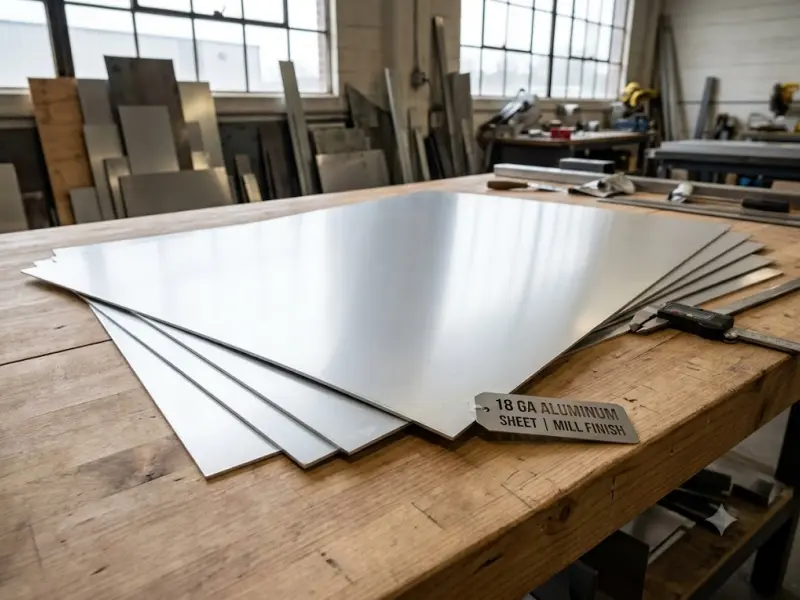
Cold work changes the metal on a grain level. This creates real differences in how the material performs under load.
Mild Carbon Steel Comparison
| Property | Hot Rolled | Cold Rolled |
|---|---|---|
| Yield strength | ~250 MPa | ~350–550 MPa |
| Tensile strength | ~400 MPa | ~500–700 MPa |
| Elongation | ~25–30% | ~10–20% |
| Hardness (HRB) | 50–70 | 60–85 |
The trade-off is clear. Cold rolled metal is stronger but less stretchy. If your part needs deep drawing or tight bending, hot rolled or annealed cold rolled may be safer.
Stainless Steel 304 Comparison
| Property | Hot Rolled (No. 1) | Cold Rolled (2B) |
|---|---|---|
| Yield strength | ~205 MPa | ~310 MPa |
| Hardness (HB) | ~150 | ~180 |
Aluminum 5052 Comparison
| Property | Hot Rolled | Cold Rolled (H32) |
|---|---|---|
| Yield strength | ~90 MPa | ~195 MPa |
| Elongation | ~25% | ~12% |
Price Tag Reality: Why One Costs More
Cold rolled metal costs more per ton. The reasons are simple.
| Cost Driver | Hot Rolled | Cold Rolled |
|---|---|---|
| Energy use | High heat, but one step | Lower heat, but multiple steps |
| Processing steps | Roll, cool, coil | Roll, pickle, cold roll, anneal, skin pass |
| Yield loss | Lower | Higher (trim, scrap) |
| Surface prep | Buyer often handles | Included in mill finish |
| Tight tolerance | Harder to hold | Built into process |
For many structural jobs, the lower price of hot rolled metal wins. For precision parts, the saved machining and finishing time often pays back the higher material cost.
Difference between hot and cold rolling
Hot Rolled Product Lineup
Hot rolling creates the heavyweights of the metal world.
Hot rolled plate: Thick slabs for pressure vessels and ship hulls
Hot rolled sheet and coil: General plate for welding and fabrication
Hot rolled strip: Wide band for pipe making and roll forming
Angle iron: L-shaped structural bars
Channel: C-shaped support beams
I-beams and H-beams: Building frames and bridges
Rebar: Ribbed bars for concrete reinforcement
Rail profiles: Train and crane track
Hot rolled bars: Round, square, and flat bars for machining
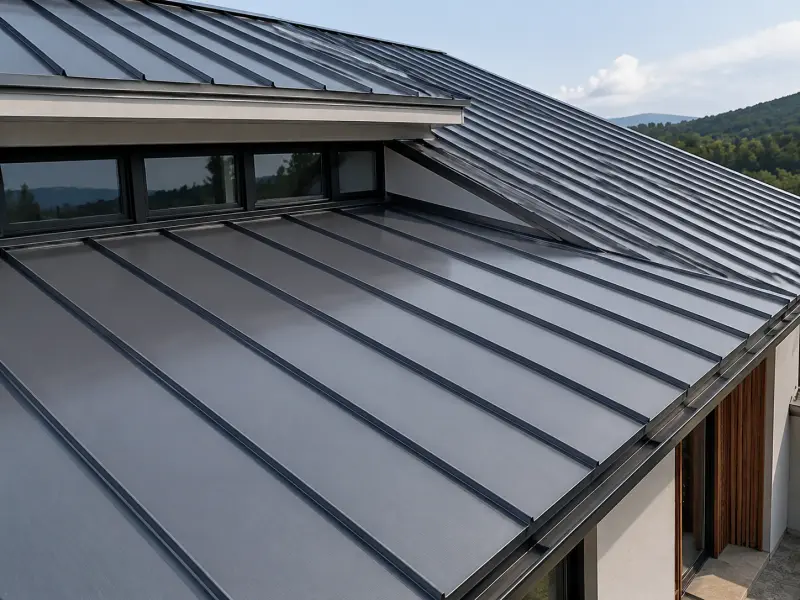
Cold Rolled Product Lineup
Cold rolling creates the precision pieces.
- Cold rolled sheet: Body panels, appliance skins, furniture
- Cold rolled strip: Narrow coil for stampings and springs
- Cold rolled foil: Food wrap, capacitor film, insulation
- Precision flat bar: Machined parts, shafts, keys
- Cold rolled square and round bar: Bright finish for visible hardware
- Tinplate: Cold rolled steel coated with tin for cans
- Galvanized sheet: Cold rolled base with zinc coating
- Electrical steel: Cold rolled silicon steel for motors and transformers
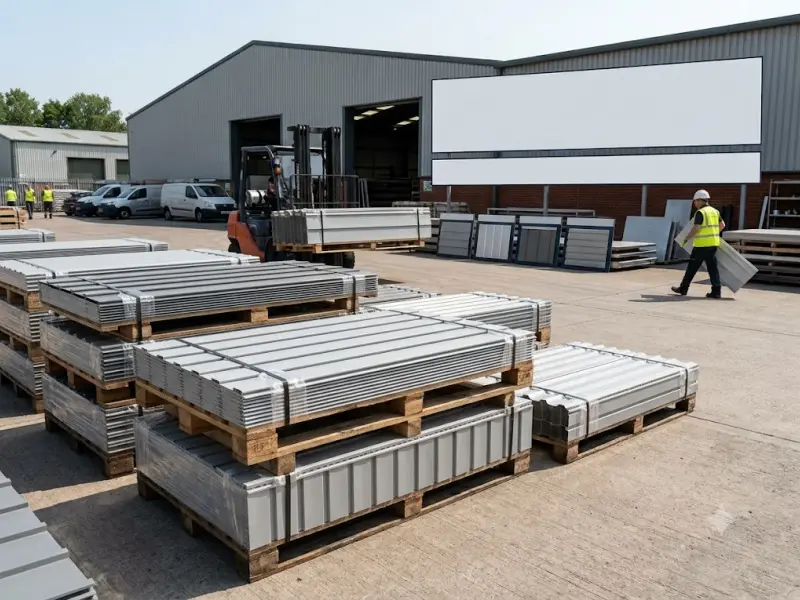
Where Hot Rolled Metal Shows Up
Hot rolled products carry loads and take abuse. You find them in places where surface looks do not matter.
- Construction: Steel frames, columns, bridge girders
- Infrastructure: Railway tracks, highway guardrails
- Shipbuilding: Hull plate, deck sections
- Heavy machinery: Base plates, gear blanks, crane booms
- Agriculture: Tractor frames, plow shares, trailer beds
- Oil and gas: Pipeline segments, storage tank walls
- Mining: Dump truck beds, crusher liners

Making the Right Pick for Your Job
Use this quick guide to decide which process fits your project.
| Question | If Yes | Choose |
|---|---|---|
| Does the part carry heavy loads? | Yes | Hot rolled |
| Is surface finish critical? | Yes | Cold rolled |
| Is the part thicker than 6 mm? | Yes | Hot rolled |
| Do you need tight tolerances? | Yes | Cold rolled |
| Will the part be painted or plated? | Yes | Cold rolled |
| Is cost the top priority? | Yes | Hot rolled |
| Do you need to weld complex joints? | Yes | Hot rolled or annealed cold rolled |
| Is the part a thin stamping? | Yes | Cold rolled |
Industries That Rely on Cold Rolled Sheets
Cold rolled metal shows up where fit, finish, and precision count.
Medical: Instrument trays, implant blanks, device housings
Automotive: Door skins, hoods, trunk lids, fenders
Appliances: Refrigerator doors, washer drums, oven panels
Electronics: Computer chassis, server racks, shielding cans
Furniture: Office cabinets, shelving, chair frames
Construction: Metal studs, track, ceiling grid
Food packaging: Cans, lids, foil containers
Aerospace: Precision shims, brackets, thin skins
Frequently Asked Questions
Is hot rolled steel weaker than cold rolled steel?
Yes, in most cases. Hot rolled steel has lower yield strength because the grains recrystallize during rolling. Cold rolled steel work-hardens and becomes stronger. However, hot rolled steel can be just as strong if you choose a higher alloy grade or if you heat-treat it after forming.
Can you weld hot rolled metal without cleaning it first?
You can, but you should not. Mill scale on hot rolled steel contains oxides that contaminate welds. The weld may look fine at first but can crack later. Grind or blast the joint area before welding. For critical joints, pickling is even better.
Why does cold rolled metal cost more?
Cold rolling takes more steps. The mill must pickle the hot rolled feed, cold roll it, anneal it, and sometimes skin-pass it. Each step adds time, energy, and labor. The tighter tolerances also create more scrap. You pay for the precision and the smooth surface.
Which process works better for stainless steel?
Both work well, but for different ends. Hot rolling is best for thick plate and industrial tanks. Cold rolling is best for kitchen equipment, elevator panels, and anything that needs a bright finish. Most stainless sheet under 3 mm is cold rolled.
What thickness is the limit for cold rolling?
Practical cold rolling of steel stops around 6 mm for standard mills. Specialized mills can cold roll up to 12 mm, but this is rare. For aluminum, cold rolling can start from much thicker slab because aluminum is softer. Foil below 0.01 mm is possible with multi-pass cold mills.
Does hot rolled metal rust faster?
Hot rolled metal rusts at about the same rate as cold rolled metal if both are bare steel. The mill scale on hot rolled steel actually slows rust for a few weeks. Once the scale cracks or flakes, rust spreads underneath. Cold rolled steel has no scale, so it rusts evenly from day one if left unprotected.
Can I paint hot rolled steel directly?
Only if the mill scale is tight and clean. In practice, scale flakes and takes paint with it. For durable paint, remove scale by sandblasting, grinding, or acid pickling. Then apply primer within a few hours to prevent flash rust. Cold rolled steel needs only degreasing before paint.
Is cold rolled metal magnetic?
Cold rolling does not change whether a metal is magnetic. Carbon steel is magnetic in both hot and cold forms. Austenitic stainless steel like 304 is normally non-magnetic, but cold rolling can create a small amount of martensite that makes it slightly magnetic. Ferritic stainless steels like 430 are magnetic regardless of rolling method.